
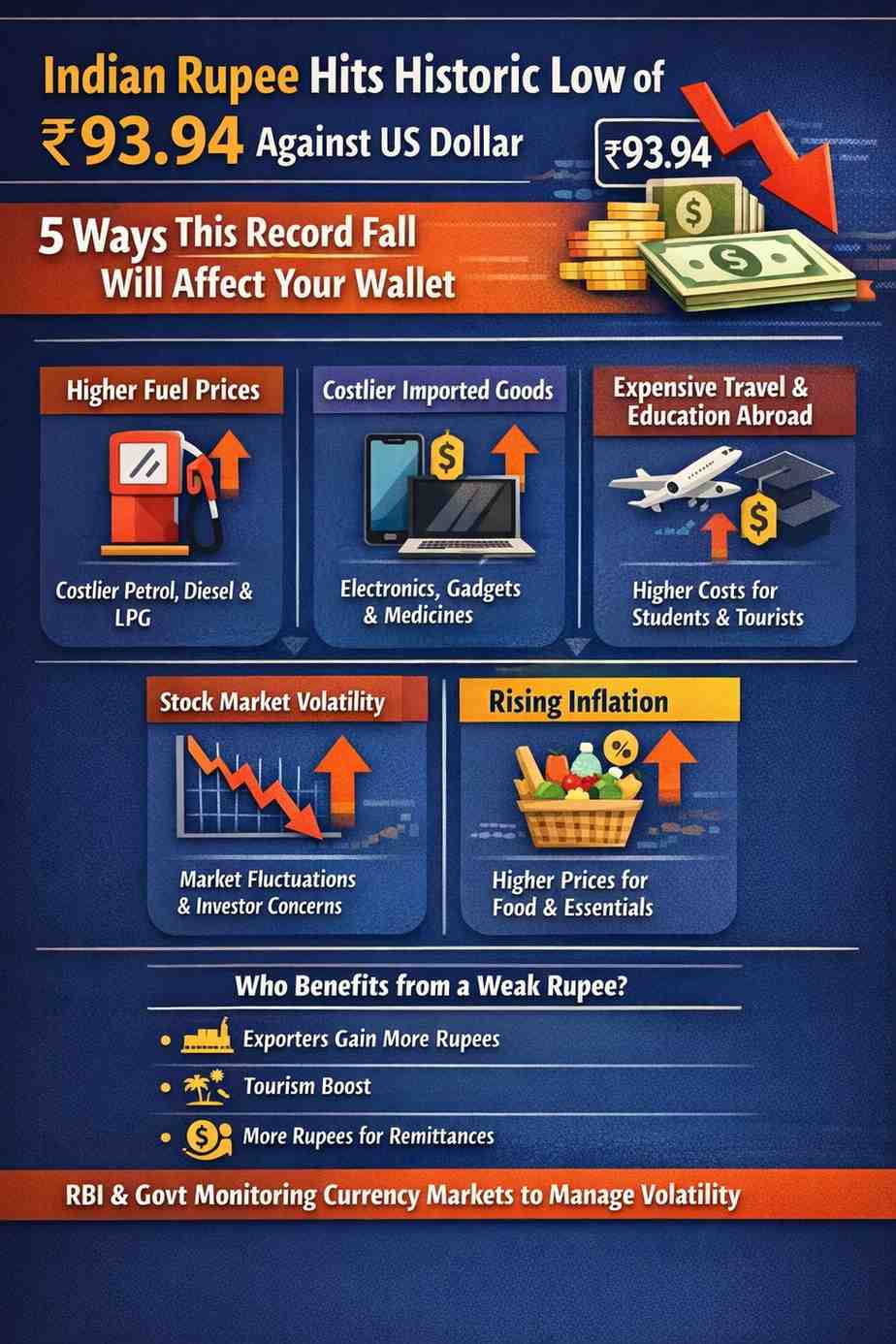
The Indian Rupee slid to an all-time low of ₹93.94 against the US Dollar in early trade on Friday, marking a historic depreciation amid surging global crude oil prices and heightened geopolitical uncertainty in West Asia. The sharp fall has triggered widespread concern among investors, businesses, and households, with search trends dominated by queries such as “Why is the rupee falling?” and “How will currency depreciation affect daily expenses?”
Market participants attribute the decline to a combination of rising oil import bills, foreign investor outflows, and a strengthening US currency globally. As India remains heavily dependent on energy imports, currency volatility is likely to have far-reaching economic implications. 💱
Why the Rupee Has Fallen to Record Levels
Currency markets have witnessed heightened volatility in recent weeks due to escalating geopolitical tensions and commodity price shocks.
1. Surge in Crude Oil Prices
Global benchmark crude prices have reportedly climbed above $114 per barrel, significantly increasing India’s import costs. Since India imports a large portion of its energy requirements, higher oil prices typically weaken the rupee by widening the current account deficit.
Rising crude also affects inflation expectations, prompting investors to reassess emerging market exposures.
2. Foreign Institutional Investor (FII) Outflows
Persistent selling by overseas investors has put additional pressure on Indian financial markets. When foreign investors withdraw capital, demand for the US Dollar increases, contributing to rupee depreciation.
Analysts say risk-off sentiment has intensified due to global uncertainties, prompting investors to shift funds toward perceived safe-haven assets.
3. Strengthening of the US Dollar
The US Dollar has strengthened against several global currencies amid expectations of tighter monetary policy and robust economic indicators in advanced economies.
A stronger dollar makes emerging market currencies like the rupee more vulnerable, particularly during periods of external shocks.
4. Trade Imbalance and Import Demand
India’s import-heavy trade structure — especially in sectors like energy, electronics, and defence — means that currency weakness can quickly translate into higher costs for businesses and consumers.
Currency depreciation can also influence corporate balance sheets, especially for firms with significant foreign currency liabilities.
5 Ways the Record Rupee Fall Will Affect Your Wallet
For ordinary citizens, currency movements may seem distant — but their impact is often direct and tangible.
Higher Fuel Prices
A weaker rupee makes imported crude oil more expensive in local currency terms. This can lead to increased petrol, diesel, and cooking gas prices over time, depending on government policy and taxation adjustments.
Costlier Imported Goods
Products such as smartphones, electronics, luxury items, and certain medicines could become more expensive as importers pass on higher costs to consumers.
Technology devices manufactured by global brands like Apple Inc. and Samsung Electronics may see pricing pressures if currency weakness persists.
Impact on Travel and Education Abroad
Students planning overseas education and families travelling internationally may face higher expenses due to increased demand for foreign exchange.
Airfares and hotel costs denominated in dollars can also become more expensive.
Stock Market Volatility
Currency depreciation often coincides with fluctuations in equity markets, as foreign investor sentiment influences capital flows.
Companies dependent on imports or with dollar-denominated debt may see profit margins squeezed, potentially affecting share prices.
Inflationary Pressures
As input costs rise across industries, businesses may adjust product pricing. Over time, this can contribute to broader inflation trends affecting food, transportation, and consumer goods.
Who Benefits From a Weak Rupee?
While currency depreciation presents challenges, it can also create opportunities for certain sectors.
Export-Oriented Industries
Companies in IT services, pharmaceuticals, textiles, and manufacturing may benefit as their dollar earnings translate into higher rupee revenues.
Tourism and Hospitality
A weaker currency can make India more attractive to international tourists, potentially boosting inbound travel demand.
Remittance Recipients
Families receiving money from relatives working abroad may gain from improved conversion rates.
Economists emphasise that the overall impact depends on the duration and magnitude of currency movements.
Policy Response: What Can Authorities Do?
The Reserve Bank of India (RBI) typically monitors currency volatility closely and may intervene in forex markets to prevent excessive fluctuations.
Possible policy tools include:
- Selling US Dollar reserves to stabilise exchange rates
- Adjusting interest rate signals
- Enhancing liquidity management
- Coordinating with the government on trade and fiscal measures
Authorities may also focus on structural reforms aimed at reducing import dependence and strengthening export competitiveness.
Global Context: Emerging Market Currency Pressures
India is not alone in facing currency challenges. Several emerging economies have experienced depreciation amid global monetary tightening and geopolitical risks.
Market experts say currencies often move in cycles influenced by macroeconomic trends, commodity prices, and investor risk appetite.
Long-term stability depends on factors such as:
- Sustainable economic growth
- Fiscal discipline
- External sector resilience
- Policy credibility
What Investors Should Consider Now
Financial advisers generally recommend avoiding panic-driven decisions during periods of market turbulence.
Instead, investors may consider:
- Reviewing asset allocation strategies
- Maintaining diversification across sectors and geographies
- Monitoring macroeconomic developments
- Staying aligned with long-term investment goals
Currency movements can create both risks and opportunities depending on portfolio composition.
Conclusion
The Indian Rupee’s fall to a historic low of ₹93.94 against the US Dollar reflects a complex interplay of global energy shocks, investor sentiment, and domestic economic dynamics. While the immediate impact may be felt through higher import costs and market volatility, policy measures and structural strengths could help mitigate long-term risks.
For households and businesses alike, understanding how currency trends influence everyday expenses and financial planning will be crucial in navigating this uncertain phase. As global conditions evolve, the trajectory of the rupee will remain a key indicator of India’s economic resilience in an increasingly interconnected world. 📊
About the Author