
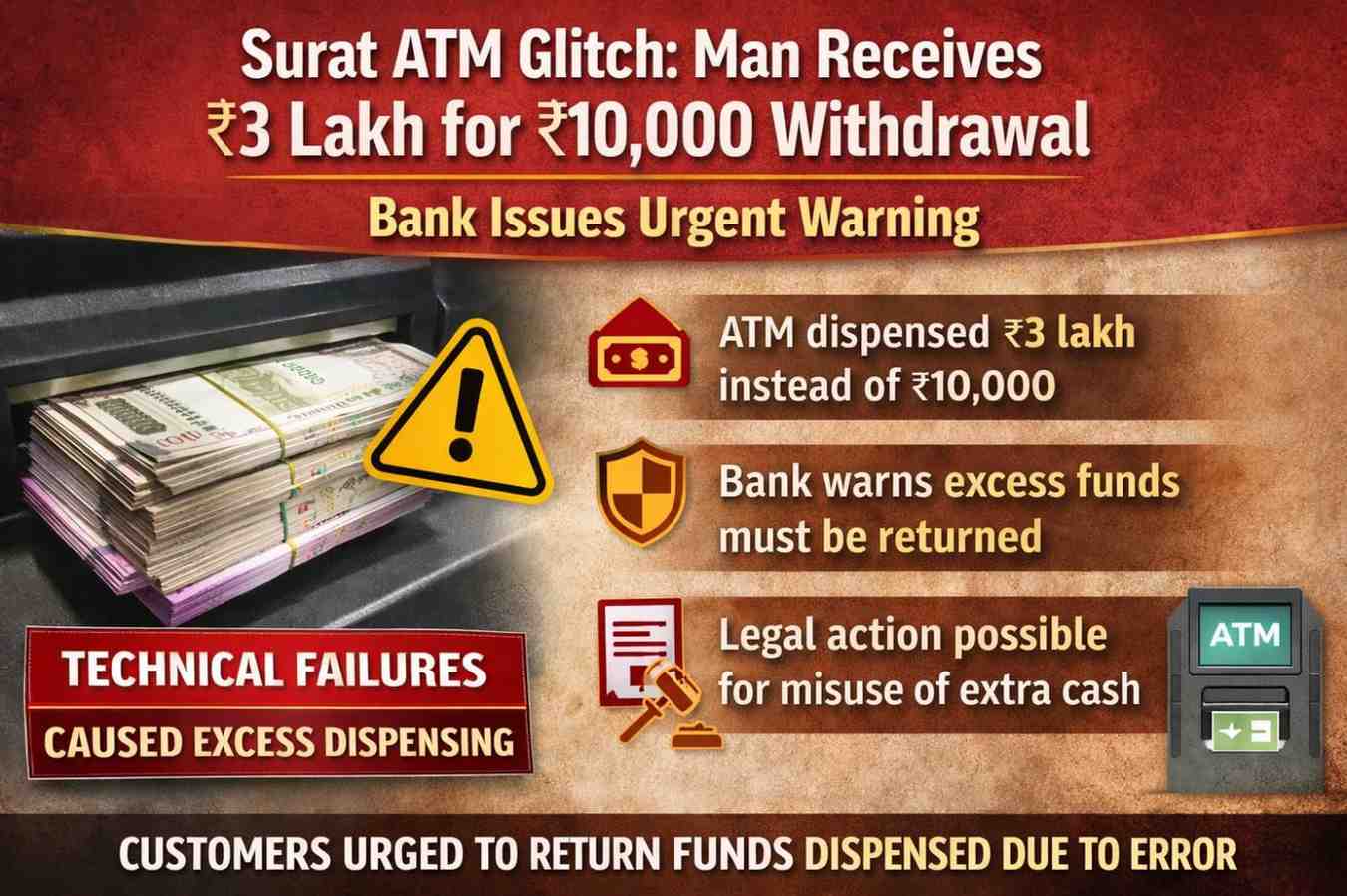
A major technical glitch at an automated teller machine (ATM) in Surat has sparked widespread concern after a man reportedly received ₹3 lakh despite attempting to withdraw only ₹10,000. The unexpected incident, which quickly drew crowds and triggered a local frenzy, has raised fresh questions about banking system safeguards, ATM network monitoring, and customer liability during digital transaction failures.
Bank officials have since acknowledged the malfunction and issued an urgent advisory to customers, urging restraint and warning of legal consequences for misuse of excess funds credited or dispensed due to system errors.
What Happened: ATM Dispenses Excess Cash Amid Technical Failure
According to initial reports from local authorities and eyewitness accounts, the incident unfolded when a resident visited an ATM kiosk to withdraw ₹10,000. Instead of dispensing the requested amount, the machine allegedly continued to release additional cash bundles, ultimately totaling approximately ₹3 lakh.
News of the malfunction spread rapidly in nearby neighbourhoods, drawing a surge of onlookers and customers hoping to attempt withdrawals. Some reports suggest long queues formed within minutes as word of the “cash glitch” circulated via messaging platforms and social media.
Such incidents, while rare, tend to escalate quickly due to the perception of “free money,” especially when crowd dynamics and viral misinformation fuel panic or opportunistic behaviour.
Bank Responds with Urgent Warning to Customers
Following the disruption, the concerned bank — whose identity has not been officially confirmed in public statements — moved swiftly to disable the affected ATM and begin a reconciliation process.
In a cautionary advisory, officials reminded customers that any excess cash received due to a technical error must be returned. Retaining funds not rightfully withdrawn can attract legal action under financial regulations and criminal statutes related to wrongful gain.
Banks typically track all ATM transactions through backend reconciliation systems, making it difficult for individuals to evade accountability. Customers are therefore advised to report anomalies immediately and avoid attempting repeated withdrawals in case of suspected malfunction.
How ATM Glitches Occur: Technical and Operational Factors
ATM networks operate through complex integrations involving core banking systems, payment switches, card authentication servers, and hardware cash dispensers. A failure at any point in this chain can result in errors such as:
1. Cash Dispenser Malfunction
Mechanical faults in note-counting or dispensing units may cause machines to release incorrect denominations or quantities.
2. Software Synchronisation Issues
If transaction approval messages fail to sync properly with cash dispensing commands, an ATM may dispense funds without accurately recording the debit.
3. Network Latency or Connectivity Failure
Delayed responses between the ATM and bank servers can create “ghost transactions,” where the machine acts on outdated or repeated instructions.
4. Maintenance or Cash Loading Errors
Incorrect calibration or human error during routine servicing can also contribute to abnormal functioning.
Industry experts note that while digital banking infrastructure in India has improved significantly in reliability and security, isolated glitches remain possible due to the scale of operations and diverse hardware environments.
Regulatory Framework: Customer Responsibility During Banking Errors
Financial regulators, including the Reserve Bank of India (RBI), have laid down guidelines on handling failed or incorrect ATM transactions.
Under existing norms:
- Customers must report disputed or abnormal transactions promptly.
- Banks are required to investigate and resolve issues within prescribed timelines.
- Wrongful retention of excess funds may be treated as misappropriation.
- Transaction trails are preserved for audit and dispute resolution.
These safeguards aim to balance consumer protection with system integrity, ensuring that genuine errors do not become avenues for financial misconduct.
Crowd Frenzy and Social Media Amplification
One of the defining aspects of the Surat incident was the rapid spread of information through social media channels. Videos and messages allegedly describing “unlimited cash withdrawals” circulated widely, intensifying the rush at the ATM location.
Experts in behavioural economics say such situations can trigger herd behaviour, where individuals act based on perceived opportunity rather than verified facts. In urban centres like Surat — a major commercial hub in the state of Gujarat — the combination of high population density and digital connectivity can accelerate such responses.
Authorities often face challenges in crowd control during sudden financial anomalies, particularly when misinformation fuels unrealistic expectations.
Legal and Ethical Implications for Customers
While ATM glitches may appear to offer short-term financial gain, legal experts caution that knowingly withdrawing or retaining excess cash can have serious consequences.
Potential implications include:
- Recovery proceedings initiated by the bank
- Police complaints in cases involving deliberate exploitation
- Adverse impact on creditworthiness or banking relationships
Courts in India have previously upheld banks’ rights to reclaim wrongly credited or dispensed funds, reinforcing the principle that technological errors do not entitle customers to unjust enrichment.
Impact on Banking Trust and Digital Payments Ecosystem
Incidents like the Surat ATM glitch can temporarily erode public confidence in automated banking services, even though they remain statistically rare.
India’s digital payments ecosystem has expanded rapidly over the past decade, driven by initiatives promoting financial inclusion, real-time payment systems, and cashless transactions. Reliable ATM infrastructure continues to play a critical role in supporting this transition, particularly in semi-urban and rural areas.
Banks therefore prioritise:
- Continuous monitoring of ATM networks
- Periodic software upgrades
- Enhanced fraud detection and anomaly alerts
- Customer awareness campaigns
Maintaining trust is essential as consumers increasingly depend on automated and remote banking channels.
What Customers Should Do If They Encounter an ATM Error
Financial experts recommend the following steps if an ATM dispenses excess cash or records an incorrect transaction:
✔ Stay Calm and Avoid Multiple Withdrawals
Repeated attempts may complicate reconciliation.
✔ Preserve Transaction Evidence
Keep receipts, note timestamps, and capture screenshots if applicable.
✔ Inform the Bank Immediately
Use helplines, branch visits, or official apps to report anomalies.
✔ Do Not Spend Excess Funds
Wait for bank clarification to avoid legal complications.
✔ Monitor Account Statements
Ensure that debits or reversals are processed correctly.
Proactive communication often leads to faster resolution and prevents disputes.
Authorities Urge Public Cooperation
Local law enforcement and bank representatives in Surat have appealed to residents to cooperate during the ongoing investigation. They emphasised that ATM glitches are technical incidents requiring orderly handling rather than opportunistic reactions.
Officials also warned against spreading unverified information online, noting that rumours can disrupt public order and strain financial services.
Conclusion: Rare Glitch Highlights Need for Vigilance
The Surat ATM glitch serves as a reminder that even advanced banking systems are not immune to technical disruptions. While the incident has drawn significant attention due to the unusually large amount dispensed, authorities stress that safeguards exist to detect and correct such anomalies.
For customers, the key takeaway is clear: transparency and timely reporting are essential when financial irregularities occur. As India’s banking infrastructure continues to modernise, maintaining public trust will depend not only on technological resilience but also on responsible consumer behaviour.
In the coming days, further clarity is expected as the bank completes its reconciliation process and determines the exact cause of the malfunction. Until then, regulators and financial institutions are likely to reinforce awareness around safe ATM usage and transaction accountability — ensuring that isolated glitches do not undermine confidence in the broader digital finance ecosystem. 💳⚠️
About the Author