
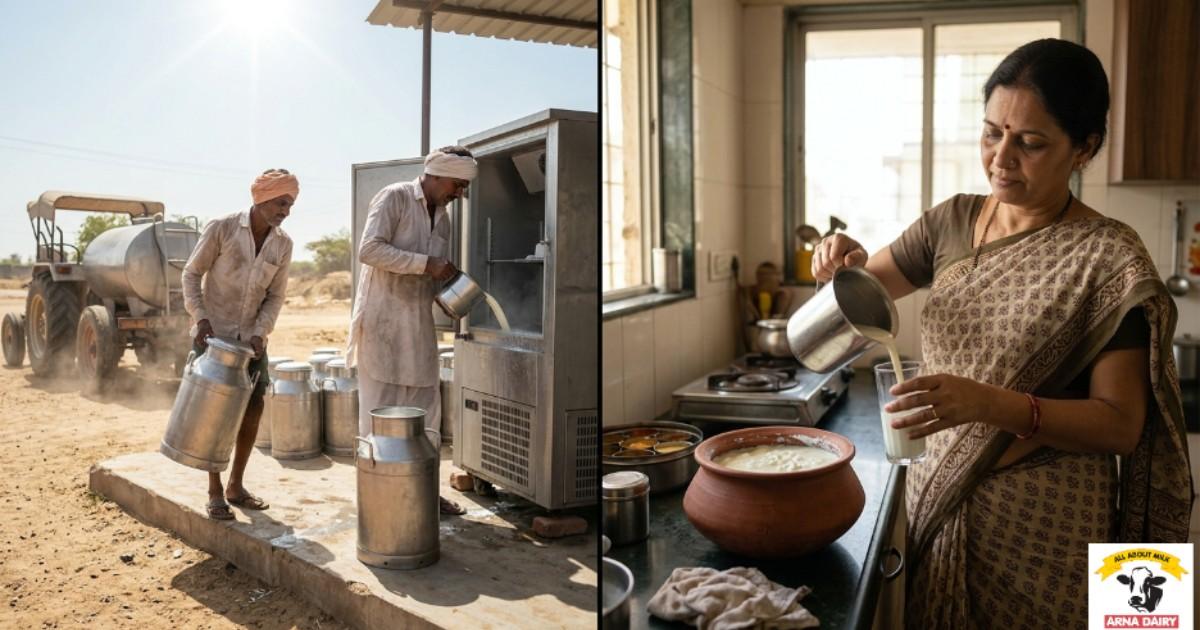
Summer doesn’t just change how we feel — it changes how milk behaves.
Most households notice it first in small, frustrating ways. The curd sets faster, then turns sour too quickly. Milk spoils earlier than expected. Paneer yield drops. Tea tastes slightly different, even when nothing in the recipe has changed.
And the immediate assumption is usually simple: “It’s just the heat.”
That explanation is partly true — but incomplete. Because what actually changes in summer is not just temperature, but the entire biological and logistical environment that milk travels through before it reaches your kitchen.
And this is where most brands stay silent.
What summer actually does to milk
Milk is a sensitive biological product. It does not behave like a static commodity. Its quality is shaped continuously — from the farm, through collection, storage, transport, and finally processing.
In summer, three key things happen simultaneously:
1. Bacterial activity accelerates
Higher ambient temperatures speed up microbial growth. If milk is not chilled quickly and consistently, acidity begins to rise faster than usual. This directly impacts taste, shelf life, and curd-setting behaviour.
Even a small delay in cooling at the collection stage can change the entire outcome.
2. Cold chain stress increases
India’s dairy system depends heavily on uninterrupted cooling — from collection centres to transport tankers to processing units.
In summer, maintaining this chain becomes significantly harder. Any weak link — a delayed pickup, overloaded chiller, or inconsistent transport timing — can quietly reduce milk stability without visible signs at the point of purchase.
Milk may still look normal. But its internal balance has already shifted.
3. Fat and SNF behaviour becomes more sensitive
Milk solids — especially SNF (Solids Not Fat) — determine structure, yield, and consistency in downstream products like curd and paneer.
In warmer conditions, variations in SNF and fat distribution become more noticeable. This is why two batches of milk that seem identical can produce very different results in home kitchens during summer.
Why you notice it at home — but not in marketing
Consumers experience the effects directly:
- Curd that behaves unpredictably
- Milk that spoils faster
- Paneer that yields less
- Slight inconsistency in taste
But most brands do not communicate these seasonal shifts openly.
Why?
Because it complicates the idea of “standard milk.”
Marketing prefers stability. Reality is more dynamic.
Explaining seasonal variation requires acknowledging that milk quality is not just about sourcing — it is about continuous control across a living supply chain.
Where quality actually breaks in summer
Most quality issues do not begin in the packet.
They begin earlier:
- At the collection point, if chilling is delayed
- During transport, if temperature fluctuates
- At processing, if batch testing is not consistent
- Or at storage, if cold chain discipline weakens even slightly
By the time milk reaches the consumer, the variation has already happened.
And because it is invisible, it is often misunderstood as inconsistency in the kitchen.
Why this matters more in summer than any other season
In winter, small inefficiencies are masked by lower ambient temperatures. Milk is naturally more stable.
In summer, everything is exposed.
That is why this season is the real test of any dairy system — not just in terms of output, but in terms of discipline.
Consistency in summer is not accidental. It is engineered.
What reliable dairy systems do differently
Dairies that maintain consistency in summer do not rely on chance. They rely on structure:
- Faster chilling at collection level
- Strict cold chain monitoring end-to-end
- Batch-wise testing for acidity, SNF, and fat
- Controlled dispatch timing based on temperature conditions
- Reduced tolerance for deviation in processing standards
It is not one intervention. It is a system of controls working together.
The silent gap most consumers never see
When milk performs consistently in summer, it is rarely because conditions were easy.
It is because the system absorbed the stress before the milk reached the home.
When it doesn’t, the failure is not always visible in the supply chain — it is visible in the kitchen.
And that gap is where most of the misunderstanding happens.
Final thought
Milk doesn’t change in summer.
The environment around it does.
And the difference between “good milk” and “inconsistent milk” is often not the product itself — but how well the system holds under seasonal pressure.
That is the part most brands don’t talk about.
But it is exactly the part that determines what you experience every morning.
About the Author