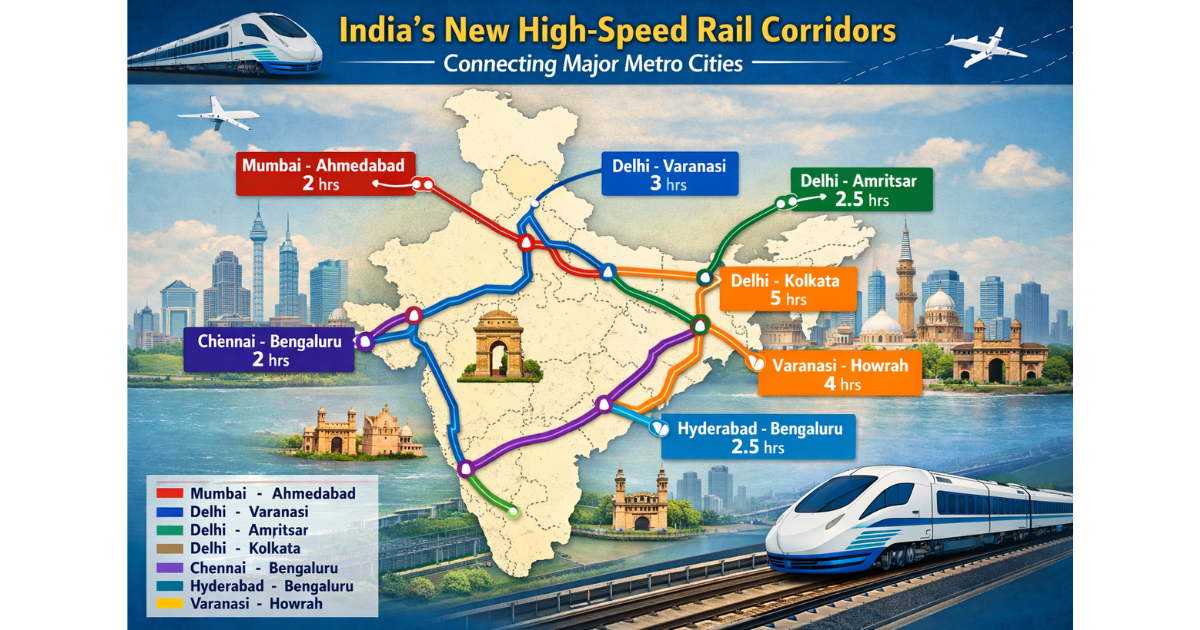
India’s ambitious vision to revolutionize its transportation landscape is steadily taking shape with the development of seven new high-speed rail corridors connecting the country’s major metro cities. With the goal of significantly reducing travel times, boosting economic activity, and promoting sustainable urban mobility, these corridors promise to redefine the way Indians travel across regions.
Transforming Intercity Travel in India
The announcement of these seven high-speed rail corridors marks a pivotal step in India’s modernization of its rail infrastructure. Unlike conventional rail networks, high-speed rail systems offer trains capable of speeds exceeding 300 km/h, allowing passengers to traverse vast distances in a fraction of the time currently required. This initiative aligns with India’s larger infrastructure vision, which emphasizes connectivity, economic growth, and technological advancement.
The corridors are strategically planned to link major metro hubs and industrial centers, thereby improving not just passenger travel but also facilitating trade, tourism, and investment. With urban centers like Delhi, Mumbai, Bengaluru, Chennai, Hyderabad, Kolkata, and Ahmedabad forming part of these routes, commuters can expect a seamless integration of speed, comfort, and reliability in the coming years.
The Seven Corridors at a Glance
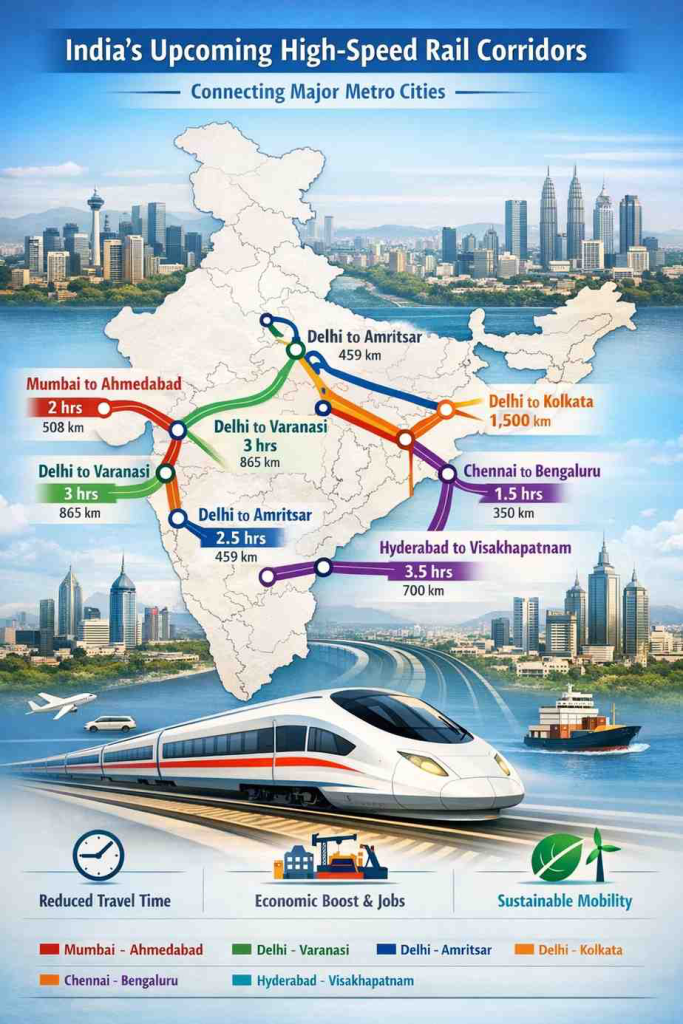
While each corridor is designed to address unique regional connectivity challenges, together they represent a nationwide transformation. The first corridor, connecting Mumbai to Ahmedabad, has already set a benchmark for high-speed rail in India, serving as a model for the remaining projects. Future corridors will integrate modern stations equipped with state-of-the-art passenger amenities, advanced signaling systems, and eco-friendly infrastructure designed to minimize environmental impact.
The corridors will not only shorten travel times but also encourage economic decentralization by making it easier for businesses and workers to operate across cities. For instance, a journey that currently takes eight hours by conventional train could be reduced to just three hours, opening new possibilities for day trips, business commutes, and regional tourism.
Economic Implications and Job Creation
Beyond transportation, these high-speed rail corridors are expected to have profound economic implications. Construction and maintenance of the lines will generate thousands of jobs, spanning sectors from civil engineering to technology and services. Local economies along the routes are likely to see growth in hospitality, retail, and logistics, as accessibility attracts new investments and tourism.
Moreover, by connecting industrial hubs with key metro cities, the corridors will facilitate faster movement of goods and raw materials, enhancing supply chain efficiency and reducing operational costs for businesses. The ripple effects are projected to stimulate economic activity not only in metropolitan centers but also in smaller cities and towns along the corridors.
Advancing Sustainability and Green Mobility
High-speed rail is inherently more energy-efficient than air travel and conventional road transport. The corridors are being designed to operate on electric traction, with renewable energy sources incorporated wherever feasible. This aligns with India’s broader climate goals of reducing carbon emissions and promoting sustainable transportation solutions.
In addition to reducing travel times, these corridors will also alleviate congestion on highways and at airports, contributing to lower pollution levels in urban areas. Urban planners and environmentalists have welcomed the initiative as a major step toward integrating modern infrastructure with sustainability imperatives.
Challenges and Future Outlook
While the vision for high-speed rail in India is ambitious, the projects face several challenges. Land acquisition, regulatory approvals, and financing are critical factors that require careful navigation. Additionally, ensuring timely project completion while maintaining high safety and quality standards is crucial for public confidence.
Nonetheless, the government has reaffirmed its commitment to the initiative, working closely with international partners and leveraging advanced technologies to accelerate development. Experts suggest that once fully operational, the seven corridors could set a global benchmark for high-speed rail networks in emerging economies, positioning India as a leader in modern, sustainable infrastructure.
Connecting the Nation at Unprecedented Speed
The development of these high-speed rail corridors signals a transformative era for India’s transportation ecosystem. By connecting major metro cities with unmatched efficiency, the corridors are expected to enhance mobility, spur economic growth, and promote sustainable travel practices. For millions of Indians, this initiative represents more than just faster trains; it is a step toward a connected, modern, and future-ready nation.
As the projects progress, travelers, businesses, and policymakers alike will be watching closely, anticipating the day when high-speed rail becomes a hallmark of India’s infrastructural prowess and a symbol of its journey toward a more interconnected future.
Add indianewsbulletin.in as a preferred source on google – click here
Last Updated on: Tuesday, February 3, 2026 11:16 am by Indian News Bulletin Team | Published by: Indian News Bulletin Team on Tuesday, February 3, 2026 11:16 am | News Categories: News
About The Author
