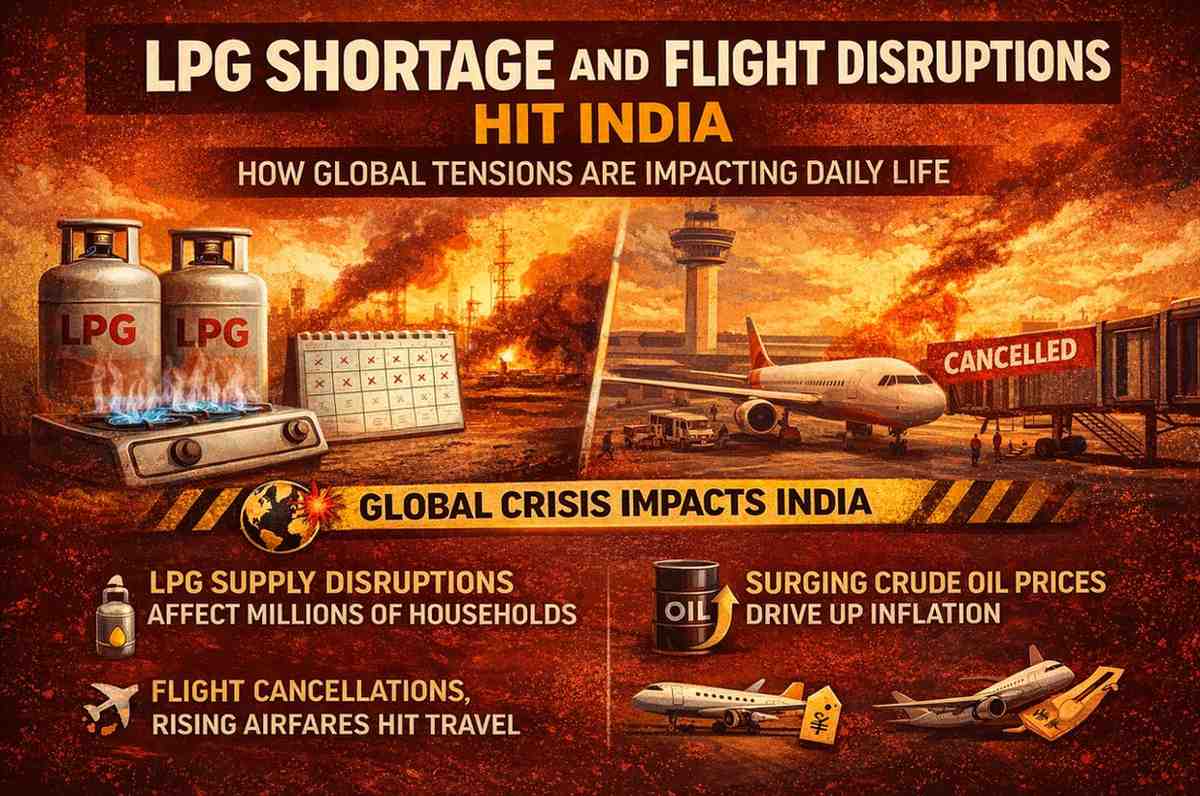
Global Conflict Sends Shockwaves to India’s Economy and Travel Sector
India is facing the ripple effects of escalating geopolitical tensions in West Asia, with disruptions in fuel supply and aviation emerging as immediate concerns. The ongoing conflict involving Iran and the United States has begun to affect critical global energy routes, particularly the Strait of Hormuz—a key artery for oil and gas shipments.
For India, which depends heavily on energy imports, the consequences are already visible. From LPG supply constraints to rising airfares and flight disruptions, the crisis is increasingly impacting everyday life, household budgets, and travel plans.
LPG Supply Disruptions Raise Concerns for Households
Supply Chain Bottlenecks in Key Energy Route
India imports a significant portion of its liquefied petroleum gas (LPG) from the Middle East, with much of it passing through the Strait of Hormuz. Any disruption in this corridor has direct consequences for domestic supply.
Recent developments indicate that tanker movement through the region has slowed considerably, leading to delays in deliveries. As a result, LPG availability has tightened in parts of the country, prompting authorities to prioritise household consumption over industrial usage.
Decline in LPG Availability
Early indicators show a noticeable drop in LPG distribution volumes in March, reflecting the strain on supply chains. While there is no official announcement of widespread shortages, concerns around availability and refill delays are trending across search platforms and social media.
For millions of Indian households that rely on LPG for daily cooking, even minor disruptions can significantly affect routine life.
Crude Oil Surge Adds Pressure on Prices and Inflation
Oil Prices Cross Critical Levels
The geopolitical crisis has led to a sharp increase in global crude oil prices, with rates crossing the $100 per barrel mark in recent days. For India, one of the world’s largest oil importers, this translates into higher import costs and increased economic pressure.
In fact, crude costs for Indian refiners have surged dramatically since the conflict began, highlighting the country’s vulnerability to external supply shocks.
Impact on Inflation and Currency
Higher oil prices have a cascading effect on the economy:
- Increased transportation and logistics costs
- Rising prices of essential goods
- Pressure on the Indian rupee
The rupee has already been trading near record lows amid global uncertainty, adding to inflation concerns. Economists warn that prolonged high oil prices could slow economic growth while pushing up consumer prices.
Aviation Sector Faces Major Disruptions
Flight Cancellations and Route Changes
The aviation sector is among the hardest hit. With parts of Middle Eastern airspace becoming unstable, airlines have been forced to cancel, divert, or reroute flights.
Recent reports confirm that flights to key destinations such as Dubai have been suspended or redirected due to safety concerns. Additionally, Indian carriers are navigating longer flight paths to avoid conflict zones, increasing travel time and operational complexity.
Rising Airfares Likely
Jet fuel prices have surged alongside crude oil, significantly increasing airline operating costs. Aviation turbine fuel typically accounts for a major portion of airline expenses, and any increase directly impacts ticket pricing.
Passengers can expect:
- Higher airfares, especially for international routes
- Longer travel durations
- Reduced flight availability on certain routes
The disruption is particularly significant for routes connecting India to Europe and North America, many of which rely on West Asian air corridors.
Wider Economic Impact on India
Energy Dependency Becomes a Key Risk
India imports a large share of its crude oil and LPG, with a substantial portion routed through the Gulf region. This dependency makes the country particularly sensitive to geopolitical instability.
Nearly half of India-bound crude shipments and most LPG supplies transit through vulnerable routes like the Strait of Hormuz, making disruptions difficult to offset in the short term.
Trade and Industry Implications
The crisis is not limited to fuel and aviation. It has broader implications:
- Increased cost of imports
- Higher freight and insurance charges
- Pressure on industries dependent on fuel inputs
Businesses may face margin pressures, especially in sectors such as transportation, logistics, and manufacturing.
Government Response and Mitigation Measures
Prioritising Domestic Needs
Authorities are reportedly focusing on ensuring uninterrupted supply for households by prioritising domestic LPG distribution over industrial consumption.
Exploring Alternative Supply Sources
India is also exploring alternative crude sourcing strategies to reduce immediate dependence on disrupted routes. However, shifting supply chains comes with higher costs and logistical challenges.
Experts note that while India has the capacity to manage short-term disruptions, prolonged instability could require more structural adjustments in energy sourcing and storage.
What This Means for Indian Consumers
Immediate Impact
For the average Indian consumer, the effects are already becoming visible:
- Possible delays in LPG cylinder deliveries
- Rising fuel-related costs
- Expensive flight tickets and travel disruptions
Medium-Term Concerns
If the situation persists, consumers may experience:
- Higher inflation across essential goods
- Increased utility and transportation expenses
- Reduced affordability of travel
Outlook: Uncertainty Continues
The trajectory of the crisis will depend largely on geopolitical developments in the coming weeks. Any escalation could further disrupt global supply chains, while de-escalation may stabilise markets.
For now, India remains in a reactive mode—managing immediate disruptions while preparing for potential long-term impacts.
Conclusion
The ongoing global tensions are no longer a distant geopolitical issue—they are directly influencing daily life in India. From LPG supply concerns to flight disruptions and rising costs, the impact is widespread and immediate.
As India navigates this complex situation, the focus remains on ensuring energy security, stabilising prices, and minimising disruption for citizens. However, the episode underscores a larger reality: in an interconnected world, global conflicts can quickly translate into local challenges.
Last Updated on: Tuesday, March 17, 2026 11:10 pm by Indian News Bulletin Team | Published by: Indian News Bulletin Team on Tuesday, March 17, 2026 12:48 pm | News Categories: News
About The Author
