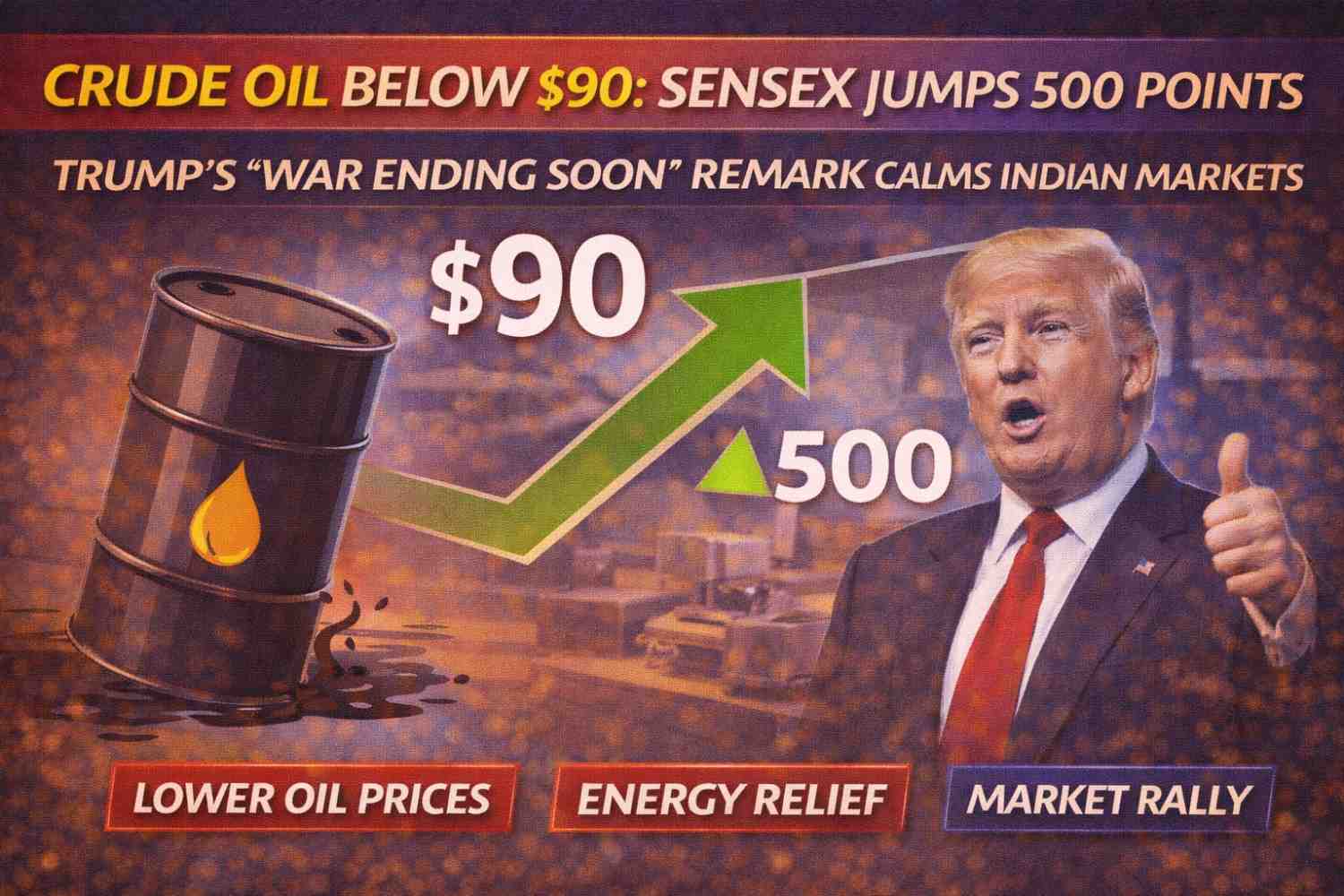
Indian financial markets witnessed a strong rebound after global crude oil prices retreated sharply from recent highs, easing concerns over energy costs and inflation. Benchmark equity index BSE Sensex surged more than 500 points in early trading after crude prices dropped toward the $90 per barrel mark following remarks by Donald Trump suggesting that the ongoing conflict in West Asia could end “very soon.”
The rapid fall in oil prices has provided relief to investors in India, a country heavily dependent on crude imports. Markets reacted quickly to the easing geopolitical risk, with banking, aviation, and oil-sensitive sectors leading gains.
The development highlights how global geopolitical tensions — particularly those affecting energy supply — can significantly influence Indian markets, inflation outlook, and investor sentiment.
Oil Prices Swing Wildly Amid Geopolitical Tensions
Over the past several days, global oil markets have experienced extreme volatility as traders reacted to developments related to the ongoing conflict involving Iran and Israel.
Crude prices initially surged above $120 per barrel amid fears of supply disruptions, particularly if tensions affected the Strait of Hormuz — one of the world’s most critical energy shipping routes. A large portion of global oil shipments passes through this narrow maritime corridor connecting the Persian Gulf to international markets.
However, oil prices quickly reversed course after comments from Donald Trump indicated that diplomatic developments could bring the conflict to an early end. The remarks triggered speculation that supply disruptions might be temporary rather than long-term.
As a result, global benchmark Brent Crude fell sharply toward $90 per barrel, easing fears of a prolonged energy shock.
For markets such as India that rely heavily on imported oil, even small price changes can have large macroeconomic implications.
Why Oil Prices Matter So Much for India
India is among the world’s largest crude oil importers, purchasing a substantial share of its energy requirements from international markets. Because domestic production meets only a fraction of demand, fluctuations in global crude prices have an immediate impact on the Indian economy.
Higher oil prices typically lead to:
- Increased fuel costs
- Higher inflation
- Pressure on government finances
- Weakening of the rupee
- Reduced corporate profitability in fuel-dependent industries
Conversely, falling oil prices tend to provide relief across multiple sectors of the economy.
When crude prices move downward, investors often interpret the development as positive for economic stability, consumer spending, and corporate margins.
The recent decline toward $90 per barrel therefore helped restore optimism in Indian equity markets.
Sensex Rally Reflects Market Relief
The benchmark Sensex index responded quickly to the easing energy concerns, rising more than 500 points in early trading.
Market participants interpreted the fall in crude prices as a sign that inflationary pressure may moderate in the near term. Lower oil prices reduce transportation costs, manufacturing expenses, and input costs across industries.
Banking stocks, aviation companies, and consumer-focused businesses were among the sectors that saw strong buying interest as investors repositioned their portfolios.
Airlines, in particular, benefit significantly from lower fuel costs because aviation turbine fuel is one of their largest operating expenses.
Similarly, transportation companies, logistics firms, and manufacturing businesses often experience improved margins when crude prices decline.
The rally also reflected renewed risk appetite among investors after several sessions of caution driven by geopolitical uncertainty.
Impact on Inflation and Monetary Policy
Oil prices play a major role in shaping inflation trends in India. Since petroleum products influence transportation costs and supply chains across the economy, sustained increases in crude prices can push consumer inflation higher.
Lower oil prices, on the other hand, can help stabilise inflation and ease pressure on policymakers.
For the Reserve Bank of India, crude oil movements are an important factor in assessing monetary policy decisions.
If oil prices remain closer to $90 rather than $120, it could provide breathing room for the central bank as it manages inflation targets while supporting economic growth.
Economists often monitor crude prices closely because sustained spikes can lead to higher interest rates, which in turn affect borrowing costs for businesses and consumers.
Rupee and Fiscal Implications
Another important factor influenced by crude oil prices is the strength of the Indian rupee.
When oil prices rise sharply, India must spend more foreign currency on energy imports, widening the country’s trade deficit. This often puts downward pressure on the rupee against the US dollar.
A decline in oil prices therefore tends to stabilise the currency and reduce external financial pressure.
Government finances are also affected because high fuel prices can increase subsidy burdens or force policy adjustments to manage inflation.
Lower crude prices help reduce fiscal stress and provide greater flexibility in public spending decisions.
These macroeconomic benefits explain why Indian markets tend to respond positively whenever global oil prices decline.
Global Markets React to Geopolitical Signals
Energy markets are extremely sensitive to geopolitical signals, particularly when conflicts occur in regions that produce or transport large quantities of oil.
The Middle East remains one of the most strategically important regions for global energy supply. Even the possibility of disruptions can trigger rapid price movements.
The recent price swings illustrate how investor expectations — shaped by political statements, diplomatic developments, and military activity — can influence commodity markets.
Financial markets across Asia and Europe also reacted positively to the fall in crude prices, reflecting broader optimism that the geopolitical situation may stabilise.
However, analysts caution that volatility may continue as the conflict evolves and new developments emerge.
Sectors That Benefit from Falling Oil Prices
Several industries in India benefit directly from lower crude prices.
Aviation: Airlines see significant cost relief because fuel is a major operating expense.
Logistics and transportation: Lower diesel prices reduce operating costs for freight companies.
Consumer goods: Reduced input and transportation costs can improve profit margins.
Automobiles: Lower fuel prices can boost consumer demand for vehicles.
Paints and chemicals: These sectors use petroleum derivatives as raw materials.
When crude prices fall, investors often increase exposure to these sectors because improved margins can translate into stronger earnings.
Risks That Still Remain
Despite the market rally, analysts warn that the situation remains uncertain.
Geopolitical conflicts are unpredictable, and any escalation in the Middle East could quickly reverse the current trend in oil prices.
If shipping routes are disrupted or energy infrastructure becomes a target in the conflict, crude prices could surge again.
Markets therefore remain sensitive to diplomatic developments and statements from global leaders.
Investors are likely to monitor developments closely before making long-term portfolio adjustments.
Market Sentiment Moving Forward
For now, the sharp drop in crude prices has helped restore investor confidence in Indian markets after days of geopolitical anxiety.
The Sensex rally reflects the broader relief that lower oil prices can bring to an import-dependent economy like India.
Market participants will continue to watch global energy prices, diplomatic negotiations, and geopolitical developments in West Asia as key indicators for the direction of both commodity markets and Indian equities.
Last Updated on: Saturday, March 14, 2026 1:31 am by Indian News Bulletin Team | Published by: Indian News Bulletin Team on Tuesday, March 10, 2026 10:50 pm | News Categories: Business
About The Author