
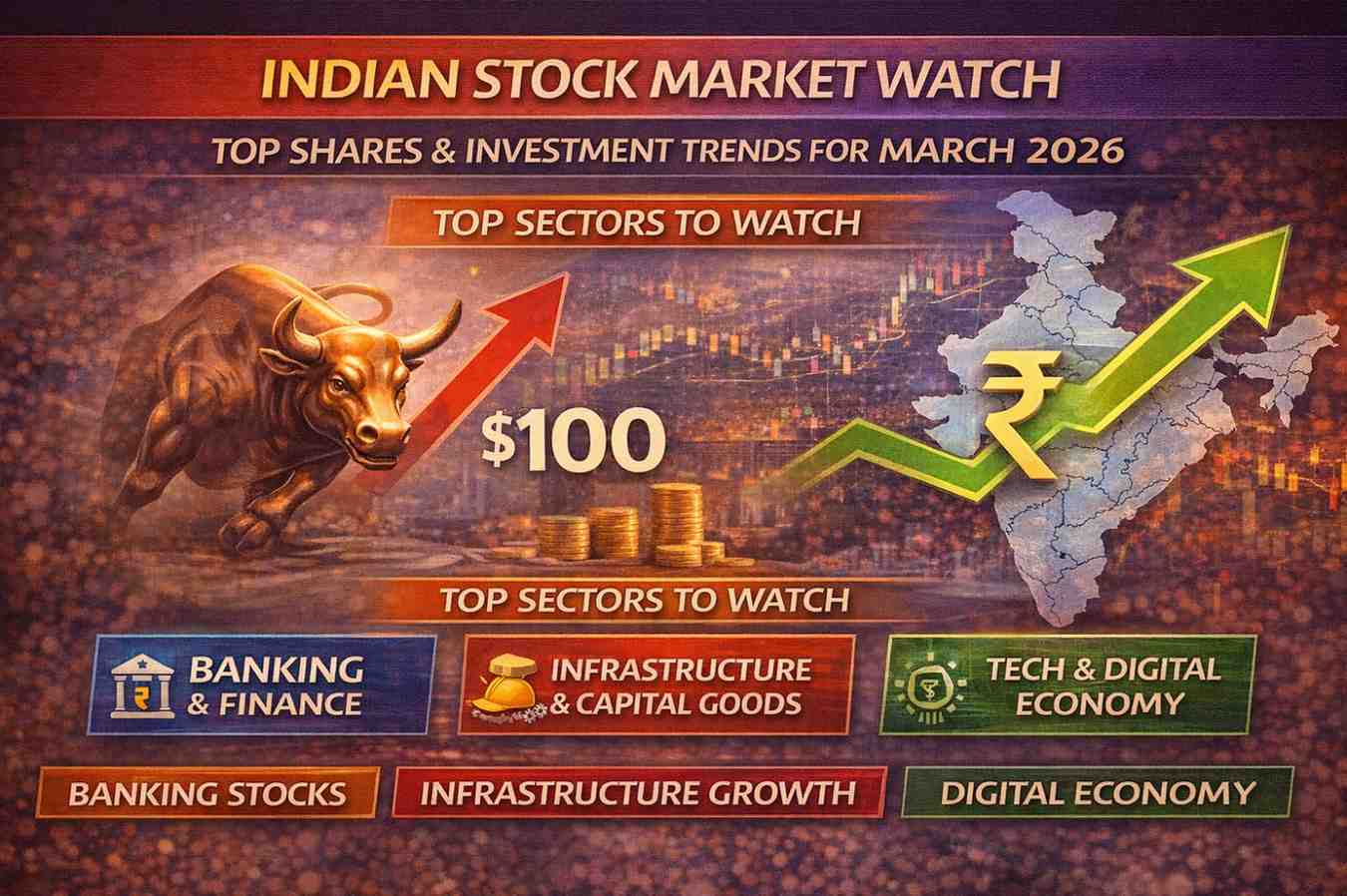
India’s equity markets are entering March 2026 amid a mix of global uncertainty, domestic growth optimism, and shifting sectoral trends. Market participants are closely tracking inflation signals, global commodity prices, and corporate earnings as they assess the outlook for equities in the coming weeks.
Benchmark indices such as the BSE Sensex and Nifty 50 continue to attract strong attention from investors, with daily search interest rising as retail participation in the stock market expands. Analysts say that while global volatility remains a factor, domestic economic fundamentals and corporate earnings expectations are shaping investment strategies for March.
With millions of Indians now actively investing through digital platforms, market outlook stories and stock recommendations have become one of the most searched financial topics online.
Indian Stock Market Performance in Early 2026
India’s equity markets have experienced periods of fluctuation in recent months as investors respond to global developments such as commodity price movements, geopolitical risks, and interest rate expectations.
Despite short-term volatility, India remains one of the fastest-growing major economies, a factor that continues to support long-term investor sentiment. Domestic consumption, infrastructure spending, and digital economy expansion are key drivers that analysts believe will support corporate growth in several sectors.
Institutional investors and retail traders alike are closely monitoring macroeconomic indicators including inflation, currency movements, and global market trends.
Key Investment Trends Emerging in March 2026
Market experts highlight several trends that are shaping investment decisions in the Indian stock market this month.
1. Continued Interest in Banking and Financial Services
The banking and financial services sector remains one of the most actively traded segments of the Indian stock market. Strong credit growth, improving asset quality, and digital banking adoption have kept investor interest high.
Large private sector banks and financial institutions continue to play a significant role in benchmark indices, making the sector an important driver of market performance.
2. Infrastructure and Capital Goods Growth
Infrastructure development remains a major theme in India’s economic policy framework. Government investment in roads, railways, and logistics networks has boosted expectations for companies involved in construction, engineering, and capital goods manufacturing.
Stocks linked to infrastructure development often see increased investor attention when major project announcements or policy initiatives are announced.
3. Technology and Digital Economy Expansion
Technology companies continue to attract long-term investors due to their role in India’s expanding digital ecosystem. Demand for services such as cloud computing, artificial intelligence, and digital transformation solutions has increased globally.
Although the IT sector can be influenced by global economic cycles, many analysts view leading technology companies as long-term growth opportunities due to their strong export revenues and innovation capabilities.
Sectors Investors Are Closely Monitoring
Several sectors are currently being tracked by analysts for potential investment opportunities in March 2026.
Banking and Financial Services
Financial institutions remain central to India’s economic expansion. Investors often evaluate banks based on credit growth trends, asset quality, and capital adequacy levels.
Energy and Oil Companies
Global crude oil price movements influence the performance of energy-related stocks. Companies involved in exploration, refining, and energy distribution may see fluctuations depending on international commodity trends.
Automobile Sector
India’s automobile industry is also being closely watched as consumer demand evolves and electric vehicle adoption gradually increases. Automakers and component manufacturers are adapting to technological changes and evolving mobility preferences.
Consumer Goods
Fast-moving consumer goods companies continue to benefit from strong domestic consumption, particularly in urban markets. Stable demand for everyday products makes this sector attractive for investors seeking relatively defensive investments.
Factors Influencing Market Sentiment
Several macroeconomic factors are currently shaping stock market sentiment in India.
Global Market Developments
Indian markets often react to international financial trends, including movements in global stock indices, commodity prices, and central bank policy decisions.
When global markets experience volatility, it can influence investor behaviour in emerging markets such as India.
Inflation and Interest Rates
Inflation trends remain a critical factor influencing monetary policy decisions by the Reserve Bank of India. Interest rate adjustments can affect borrowing costs for companies and consumers, which in turn influences economic activity and corporate earnings.
Corporate Earnings
Quarterly earnings announcements remain one of the most important indicators for stock performance. Investors analyse company financial results to evaluate revenue growth, profitability, and future guidance.
Strong earnings reports can boost investor confidence, while weaker results may trigger market corrections.
Rise of Retail Investors in India
India has witnessed a surge in retail investor participation in recent years, largely driven by digital trading platforms and increased financial awareness.
Millions of new investors have entered the equity market, contributing to higher trading volumes and greater interest in stock market news and analysis.
The growth of systematic investment plans (SIPs) and mutual fund participation has also strengthened long-term investment culture in the country.
Financial literacy campaigns and easier access to investment tools have played a role in encouraging more individuals to participate in capital markets.
Risks Investors Should Watch
While market opportunities exist, experts often caution investors to remain mindful of potential risks.
Global Economic Uncertainty
Economic developments in major economies can influence global trade, commodity prices, and financial markets. These factors may create short-term volatility in Indian equities.
Commodity Price Fluctuations
Changes in crude oil prices and other commodities can affect inflation and corporate profitability, influencing market sentiment.
Geopolitical Developments
International political developments may impact investor confidence and financial markets, particularly when they affect global trade or energy supply chains.
Importance of Long-Term Investment Strategy
Financial advisors often emphasize the importance of long-term investment strategies rather than short-term speculation.
Diversification across sectors and asset classes can help investors manage risks associated with market volatility. Long-term investors typically focus on fundamentals such as corporate earnings growth, economic expansion, and sectoral trends.
Market corrections, while sometimes unsettling, are considered a normal part of equity investing.
Outlook for the Indian Stock Market
Looking ahead, analysts believe the Indian stock market will continue to be influenced by both domestic economic developments and global financial trends.
Infrastructure spending, manufacturing growth, and the expansion of India’s digital economy remain key factors supporting long-term investment potential.
However, investors are likely to remain cautious amid global uncertainties, particularly related to commodity prices and international economic conditions.
A Market Increasingly Driven by Data and Participation
The Indian stock market has evolved significantly in recent years, becoming more accessible to individual investors and more closely connected to global financial trends.
With increasing digital participation and broader economic growth, equity markets are expected to remain an important avenue for wealth creation in India.
For investors navigating the markets in March 2026, staying informed about economic indicators, sectoral trends, and global developments will remain essential in making balanced and informed investment decisions.
About the Author