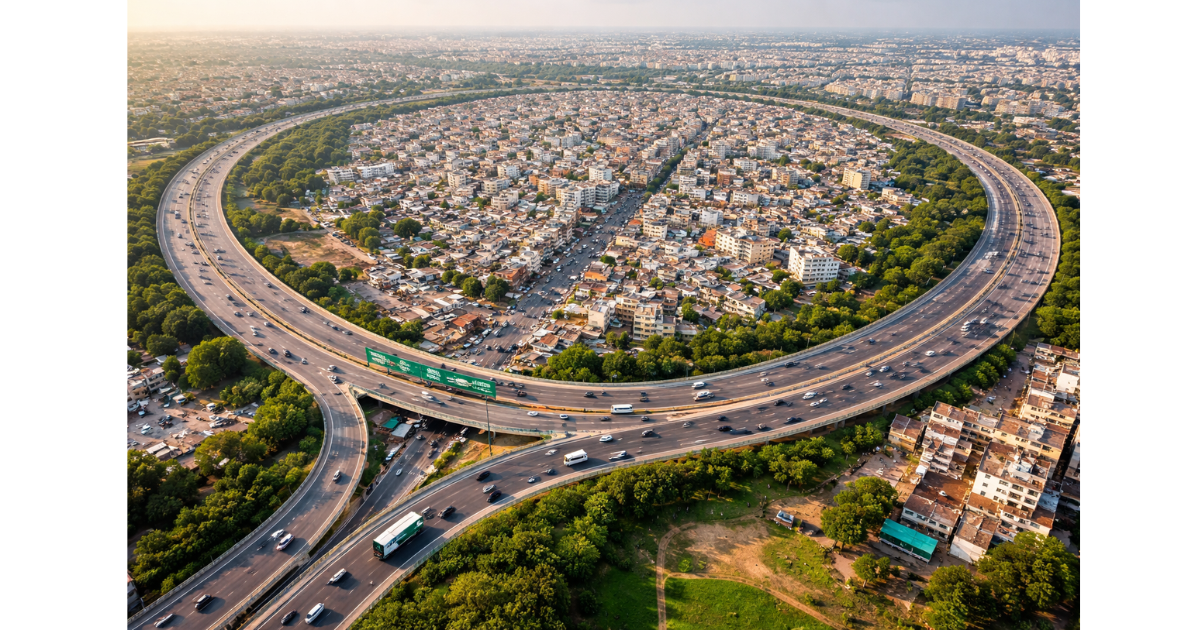
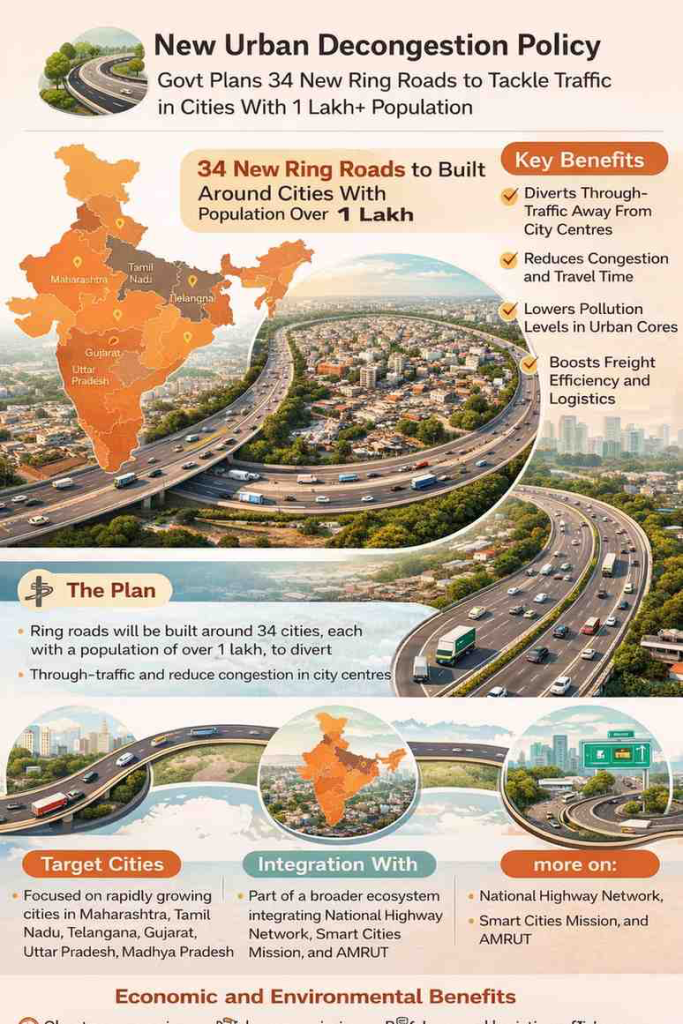
India’s chronic urban traffic problem, long seen as an unavoidable side effect of rapid growth, is now at the centre of a major policy rethink. The Union government is preparing to roll out a new Urban Decongestion Policy that proposes the construction of 34 new ring roads around cities with populations exceeding one lakh. The move marks one of the most ambitious attempts yet to systematically ease congestion, cut travel time, and improve the quality of urban life across fast-growing towns and mid-sized cities.
Officials familiar with the plan say the policy is designed to address a structural flaw in India’s urban transport network: the absence of bypass routes that divert non-local and freight traffic away from crowded city cores. As industrial activity, e-commerce logistics, and private vehicle ownership continue to surge, existing road networks in many cities have reached a breaking point.
Why Ring Roads Are Back in Focus
Ring roads are not a new idea in Indian urban planning, but their implementation has been uneven. While megacities like Delhi and Bengaluru have partial or complete ring corridors, dozens of Tier-2 and Tier-3 cities remain dependent on arterial roads that pass straight through residential and commercial zones. This forces long-distance trucks, intercity buses, and daily commuters to compete for the same limited road space.
The proposed policy seeks to correct this imbalance by creating continuous circular or semi-circular corridors around urban peripheries. These ring roads are expected to intercept through-traffic before it enters city limits, allowing inner roads to function primarily for local movement. Urban planners involved in consultations say this single intervention could reduce peak-hour congestion in some cities by 20 to 30 percent over time.
Targeting the Forgotten Middle of Urban India
Unlike earlier infrastructure pushes that focused mainly on metros, the new plan explicitly targets cities with populations above one lakh. This includes rapidly expanding industrial towns, district headquarters, and emerging regional hubs that have seen explosive growth without matching investments in road capacity.
Cities in states such as Maharashtra, Tamil Nadu, Telangana, Gujarat, Uttar Pradesh, and Madhya Pradesh are expected to feature prominently in the first phase. Many of these cities sit along national and state highways, making them natural choke points for freight and passenger movement. By building ring roads, the government hopes to separate urban mobility from regional and national traffic flows.
Integration With National Highway and Urban Missions
The ring road initiative is being designed as part of a broader transport ecosystem rather than a standalone project. According to senior officials, the corridors will be aligned with existing national highways, logistics parks, and industrial corridors wherever possible. This is intended to improve freight efficiency and reduce fuel wastage caused by stop-and-go traffic inside cities.
The policy is also expected to dovetail with flagship urban programmes such as the Smart Cities Mission and AMRUT. Ring roads could serve as spines for future public transport expansions, including bus rapid transit systems and suburban rail links, while also opening up new zones for planned urban expansion.
Economic and Environmental Payoffs
Beyond traffic relief, the government is framing the policy as an economic and environmental intervention. Congestion currently imposes heavy costs on cities in the form of lost productivity, higher logistics expenses, and increased air pollution. Studies by transport think tanks estimate that Indian cities lose billions of rupees annually due to traffic delays alone.
By smoothing traffic flow and reducing idling time, ring roads could significantly lower vehicular emissions in dense urban areas. Officials argue that cleaner air, faster commutes, and improved logistics efficiency will together enhance the overall competitiveness of cities, especially those positioning themselves as manufacturing and services hubs.
Land, Funding, and Execution Challenges
Despite its promise, the plan faces familiar hurdles. Land acquisition on city outskirts remains a sensitive issue, particularly in peri-urban areas where agricultural land values are rising rapidly. The government is reportedly exploring flexible alignment designs and state-specific compensation models to minimise disputes.
Funding is another key consideration. The ring roads are likely to be developed through a mix of central assistance, state contributions, and public-private partnerships. In some cases, land value capture and toll-based models may be used to ensure long-term financial viability.
Execution capacity at the state and municipal level will also be crucial. Past experience shows that delays often arise not from construction itself, but from coordination failures between multiple agencies. The new policy is expected to include clearer timelines, standardised design norms, and stronger monitoring mechanisms to avoid such bottlenecks.
What It Means for Urban India
If implemented effectively, the Urban Decongestion Policy could mark a turning point in how India plans mobility for its fast-growing cities. By shifting focus from reactive road widening to strategic traffic diversion, the government is acknowledging that congestion is not merely an inconvenience but a development constraint.
For millions of urban residents, the success of these 34 ring roads could mean shorter commutes, safer streets, and cleaner air. For cities, it could provide the breathing room needed to grow in a more organised and sustainable manner. As India’s urban population continues to expand, the real test will lie not in announcing ambitious plans, but in delivering roads that truly take the pressure off city life.
Add indianewsbulletin.in as a preferred source on google – click here
Last Updated on: Friday, January 30, 2026 12:11 pm by Indian News Bulletin Team | Published by: Indian News Bulletin Team on Friday, January 30, 2026 12:11 pm | News Categories: News
About The Author
