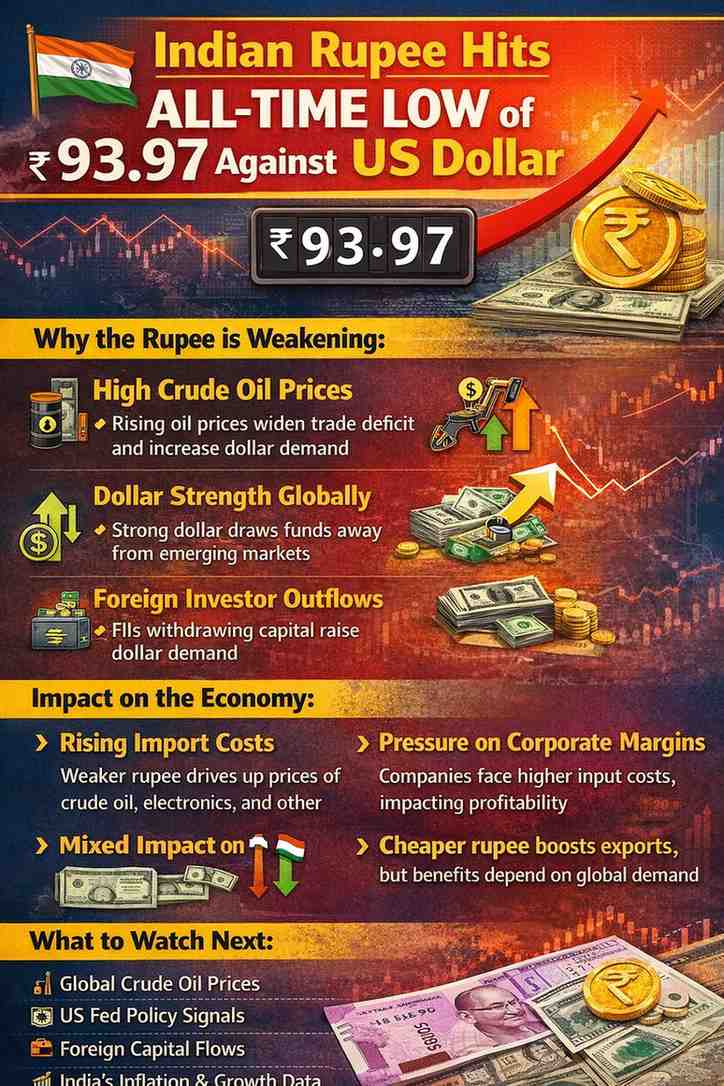
The Indian rupee plunged to a fresh record low against the US dollar on Tuesday evening, even as equity markets staged a sharp rebound earlier in the day. The currency’s fall to around the 93.97 mark has sparked widespread concern among businesses, importers, and retail investors tracking global economic developments. 💱📉
The decline highlights how currency markets often react to macroeconomic pressures differently from stock indices, which may rally on short-term sentiment shifts.
Why the Rupee is Weakening
High Crude Oil Prices Remain a Key Pressure
India is one of the world’s largest crude oil importers, making the rupee particularly sensitive to energy price movements. Sustained elevation in global oil prices increases import bills, widens the current account deficit, and raises demand for dollars among refiners and energy companies.
This structural demand for foreign currency tends to weaken the rupee, especially during periods of geopolitical uncertainty or supply disruptions.
Dollar Strength in Global Markets
The US dollar has remained firm against several emerging market currencies due to safe-haven demand and expectations around interest rate policy in major economies.
When the dollar strengthens globally, capital often flows away from riskier markets, putting pressure on local currencies such as the rupee. This trend can continue even if domestic stock markets show resilience or short-term recovery.
Foreign Investor Outflows and Hedging Activity
Currency depreciation is also influenced by foreign institutional investor (FII) behaviour. Episodes of risk aversion may lead overseas investors to reduce exposure to emerging markets or increase hedging activity, both of which can raise demand for dollars.
Such flows can amplify volatility in currency markets, particularly when combined with commodity price shocks or global financial uncertainty.
Why Sensex Rally Didn’t Support the Rupee
Indian equities witnessed strong buying interest earlier in the session amid improving global risk sentiment and hopes of geopolitical de-escalation. However, currency markets typically respond to longer-term macroeconomic fundamentals rather than intraday stock movements.
Analysts note that while equity inflows can support the rupee, their impact may be offset if structural pressures such as rising import costs and strong dollar demand persist.
Impact of Weak Rupee on the Economy
Rising Import Costs
A weaker currency increases the cost of importing goods such as crude oil, electronics, and industrial inputs. This can eventually lead to higher inflation if companies pass on increased costs to consumers.
Pressure on Corporate Margins
Businesses reliant on imported raw materials may see profitability squeezed unless they hedge currency exposure effectively or raise prices.
Mixed Impact on Exports
On the positive side, currency depreciation can improve export competitiveness by making Indian goods cheaper in global markets. However, the net benefit depends on global demand conditions and supply chain dynamics.
What the Central Bank May Watch
Market participants are closely tracking potential policy responses from the Reserve Bank of India. The central bank typically monitors exchange rate movements to ensure orderly market functioning and may intervene through liquidity measures or foreign exchange operations if volatility becomes excessive.
Interest rate signals, inflation outlook, and foreign reserve levels will remain key indicators influencing currency stability in the coming weeks.
Outlook for the Rupee
Currency experts suggest that the rupee’s trajectory will depend on multiple external and domestic triggers, including:
- Movement in global crude oil prices
- US Federal Reserve policy signals
- Foreign capital flows
- India’s inflation and growth data
- Geopolitical developments
While short-term volatility may continue, sustained stabilisation in commodity prices and renewed investment inflows could help moderate downward pressure on the rupee over time.
Last Updated on: Wednesday, March 25, 2026 12:15 am by Indian News Bulletin Team | Published by: Indian News Bulletin Team on Tuesday, March 24, 2026 3:12 pm | News Categories: Business
About The Author