India’s direct-to-consumer (D2C) ecosystem is entering a more mature and demanding phase. After years of rapid experimentation, easy capital, and aggressive customer acquisition, 2026 is shaping up to be a year where scale will depend less on hype and more on fundamentals. Recent funding rounds raised by brands such as Salty and Neeman’s offer valuable insights into what investors now expect from D2C businesses and how founders can prepare their brands for the next phase of growth.
Why 2026 Will Be a Defining Year for D2C Brands
The D2C boom that followed the pandemic created hundreds of consumer brands across fashion, food, personal care, and lifestyle categories. While this expansion brought innovation and choice, it also resulted in intense competition, rising customer acquisition costs, and pressure on margins.
By 2026, the environment is more selective. Investors are backing fewer brands, but with larger conviction, focusing on those that demonstrate repeat demand, operational efficiency, and a clear path to profitability. Scaling is no longer about growing fast at any cost; it is about growing right.
What Salty and Neeman’s Funding Signals About Investor Priorities
The recent funding rounds raised by Salty and Neeman’s highlight a clear shift in investor thinking. Both brands have built strong identities in competitive categories, but more importantly, they have demonstrated consistency in execution. Their ability to attract capital in a cautious funding climate suggests that investors are rewarding clarity of vision, disciplined growth, and credible scale strategies.
Rather than chasing vanity metrics, these brands have focused on strengthening their core offerings, improving unit economics, and building loyal customer bases. This approach aligns closely with what 2026-era investors are looking for.
Product-Market Fit Comes Before Aggressive Expansion
One of the most important lessons from recent successful D2C fundraises is the renewed emphasis on product-market fit. Brands that scale well in 2026 will be those that deeply understand their customers and deliver products that solve real problems or fulfil clear needs.
Salty’s focus on differentiated products and Neeman’s emphasis on comfort, sustainability, and everyday usability underline the importance of clarity in value proposition. Before expanding categories or geographies, brands must ensure that their core products resonate strongly with their target audience.
Building a Strong Brand, Not Just a Sales Channel
In an increasingly crowded digital marketplace, brand strength has become a critical moat. Performance marketing alone is no longer sufficient to build sustainable growth. Investors now expect D2C brands to demonstrate long-term brand equity through organic demand, word-of-mouth, and community engagement.
Salty and Neeman’s have invested consistently in brand storytelling, customer experience, and offline presence where relevant. These efforts help reduce dependence on paid advertising and create a more resilient growth engine, an essential factor for scaling in 2026.
Unit Economics and Profitability Are No Longer Optional
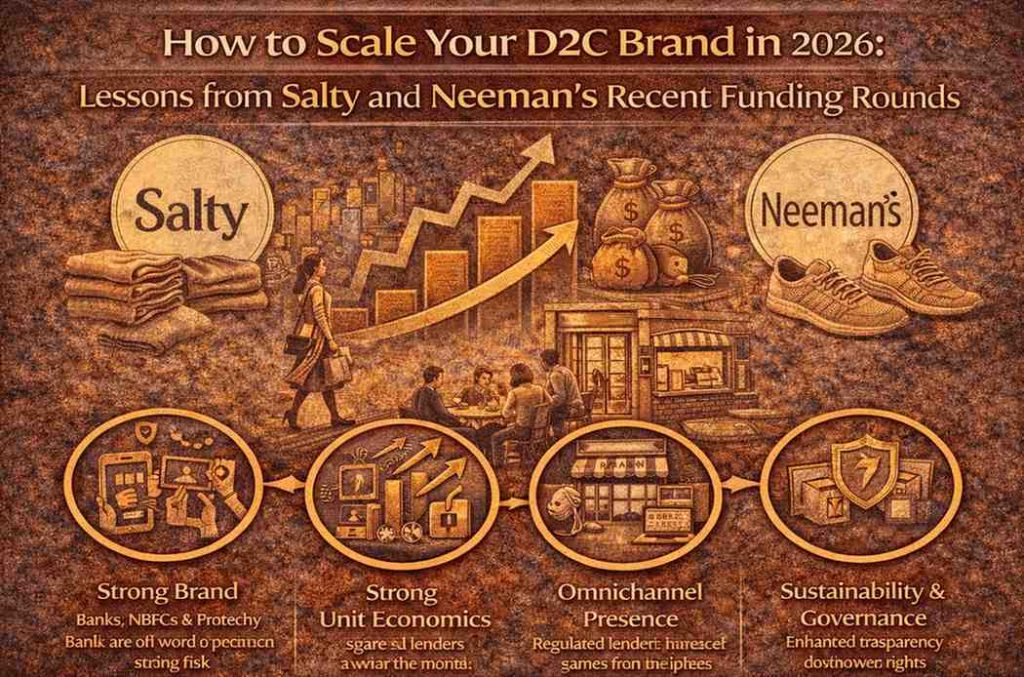
Perhaps the most decisive shift in the D2C playbook is the renewed focus on unit economics. Rising logistics costs, returns, and digital advertising expenses have exposed the fragility of growth models built on thin margins.
Brands that raised capital recently have shown improving contribution margins, tighter cost controls, and clearer profitability timelines. For founders planning to scale in 2026, this means optimising pricing, supply chains, and fulfilment operations early rather than relying on future funding to fix inefficiencies.
Omnichannel Presence as a Growth Lever
Pure-play online strategies are giving way to more balanced omnichannel approaches. Physical retail, pop-up stores, marketplaces, and partnerships are increasingly seen as tools to drive discovery, trust, and repeat purchases.
Neeman’s expansion into offline formats demonstrates how physical touchpoints can complement digital channels. For D2C brands aiming to scale, omnichannel strategies are not about abandoning digital-first roots but about meeting customers where they are and improving lifetime value.
Smarter Use of Capital and Longer Runways
The funding environment has taught founders an important lesson: capital is a tool, not a crutch. Investors backing D2C brands today expect disciplined use of funds, with a focus on extending runways and reducing dependency on frequent fundraising.
Recent funding rounds reflect this mindset, with capital often being deployed toward supply chain improvements, technology, and selective expansion rather than broad-based marketing spends. This approach is likely to define successful scaling strategies in 2026.
Talent, Systems, and Operational Discipline
As D2C brands grow, operational complexity increases rapidly. Scaling requires not just capital but also strong leadership teams, robust systems, and data-driven decision-making. Investors are increasingly evaluating the depth of management teams and the maturity of internal processes.
Brands that can demonstrate professionalised operations, reliable forecasting, and strong governance are better positioned to scale without losing control. This is a quieter but crucial lesson from recent successful D2C fundraises.
The Role of Sustainability and Conscious Consumption
Consumer preferences are evolving, with growing awareness around sustainability, ethical sourcing, and long-term value. Brands like Neeman’s, which integrate sustainability into their product narrative and operations, are finding resonance with both consumers and investors.
In 2026, sustainability is less about marketing claims and more about measurable impact. D2C brands that embed responsible practices into their supply chains are likely to enjoy stronger brand loyalty and regulatory resilience.
What Founders Should Take Away
The experiences of Salty and Neeman’s underline a broader truth about scaling D2C brands in 2026. Growth will favour brands that balance ambition with discipline, creativity with control, and storytelling with strong fundamentals.
How to scale your D2C brand in 2026 is no longer a mystery of chasing trends or burning capital. It is about building trust, improving efficiency, and making deliberate choices at every stage of growth. As the sector matures, these lessons are likely to separate enduring brands from those that struggle to survive the next phase of competition.
Also read – https://indianewsbulletin.in/the-evolution-of-the-union-budget-how-indias-economy-has-changed-since-1947/
Add indianewsbulletin.in as preferred source in google – click here
Last Updated on: Tuesday, January 27, 2026 10:32 am by Indian News Bulletin Team | Published by: Indian News Bulletin Team on Tuesday, January 27, 2026 10:32 am | News Categories: India
About The Author