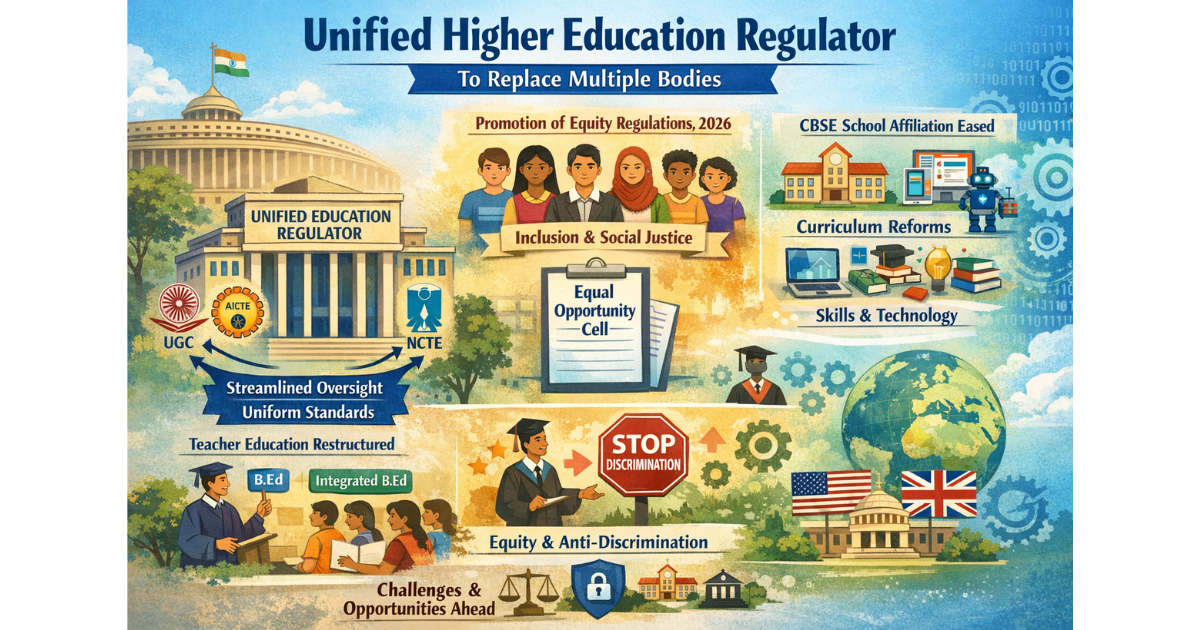
New Delhi: India’s education landscape is undergoing significant regulatory reforms that could reshape schooling and higher education across the country. From easing school affiliation norms to introducing stricter oversight of higher education institutions, the government is aiming to improve quality, equity, and global competitiveness in education.
Unified Higher Education Regulator to Replace Multiple Bodies
New Delhi: India’s education landscape is undergoing significant regulatory reforms that could reshape schooling and higher education across the country. From easing school affiliation norms to introducing stricter oversight of higher education institutions, the government is aiming to improve quality, equity, and global competitiveness in education.
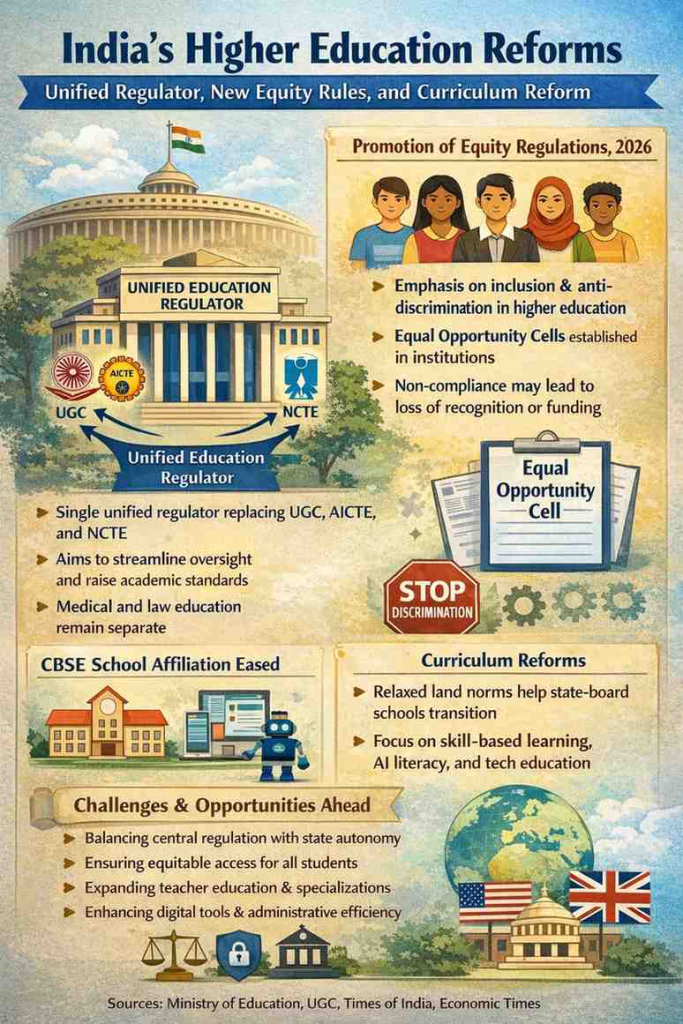
One of the most consequential developments is the move towards a single, unified regulator for higher education, which will replace multiple existing bodies such as the University Grants Commission (UGC), All India Council for Technical Education (AICTE), and the National Council for Teacher Education (NCTE). The new framework is expected to streamline accreditation, ensure academic quality, and reduce bureaucratic hurdles. While medical and law education may remain under separate oversight, the proposed regulator will oversee general, technical, and teacher education institutions. Experts say this could bring uniform standards and greater transparency, but critics argue that it might reduce state autonomy in managing local universities.
New Equity Regulations to Promote Inclusion
In addition, the UGC’s “Promotion of Equity Regulations, 2026” has come into effect, emphasizing social justice and inclusivity in higher education. Institutions are now required to establish Equal Opportunity Cells, conduct awareness workshops, and provide clear grievance mechanisms. Failure to comply could result in loss of recognition or government funding, signaling a stricter approach toward preventing caste-based and other forms of discrimination.
Schools Gain Easier Access to CBSE Affiliation
Schools are also set to experience significant change. The Central Board of Secondary Education (CBSE) has relaxed land requirements for school affiliation, enabling many budget state-board schools to transition to CBSE. This move is expected to increase the number of schools offering a nationally recognized curriculum, although parents and experts have raised concerns about potential fee hikes.
Curriculum Reforms Focus on Skills and Technology
Curriculum reforms are a major focus under the National Education Policy 2020. Schools are moving towards skill-based learning, artificial intelligence literacy, and computational thinking, emphasizing practical knowledge and employability over rote memorization. Digital tools and payment systems are also being encouraged for greater administrative efficiency and transparency.
Teacher Education Restructured for Professionalization
Teacher education is being restructured to professionalize the workforce and improve pedagogical quality. One-year BEd and MEd programs have been reintroduced for eligible candidates, while four-year Integrated Teacher Education Programmes will combine undergraduate degrees with teaching credentials. Specializations in areas such as Yoga, Arts, and Physical Education are also being expanded to diversify and enhance teacher training.
Global Trends in Education Reform
Globally, education systems are undergoing similar transformations. In the United States, regulatory reforms have reshaped accreditation, civil-rights enforcement, and student aid policies, while the United Kingdom is focusing on linking further and higher education with employability and vocational skills. Experts note that these trends reflect a global shift toward accountability, inclusivity, and skills-driven learning.
Stakeholder Reactions
Stakeholder reactions in India have been mixed. Students and families generally welcome the focus on quality but remain concerned about changing admission rules and fee structures. Educators support professionalization but emphasize the need for funding, infrastructure, and clear implementation. Some state governments caution against centralization, fearing that it could undermine local academic priorities.
Challenges and Opportunities Ahead
While these reforms offer the potential to modernize India’s education system, analysts stress that effective implementation will be critical. Ensuring equitable access, embracing digital tools, and balancing regulation with institutional autonomy will determine the success of this transformative phase.
Source: Ministry of Education, UGC, Times of India, Economic Times, Government of India
Also read :https://newsestate.in/how-recent-policy-decisions-could-influence-indias-economic-growth-outlook/
Add indianewsbulletin.in as a preferred source on google – click here
Last Updated on: Thursday, January 22, 2026 11:57 am by Indian News Bulletin Team | Published by: Indian News Bulletin Team on Thursday, January 22, 2026 11:57 am | News Categories: News
About The Author
