
Solar flares sudden, intense eruptions of electromagnetic radiation from the Sun are a natural part of the Sun’s activity cycle. Most pass unnoticed on Earth. Some, however, can disrupt radio communications, satellite operations, navigation systems and, in rare cases, power infrastructure. As India’s dependence on satellites, digital networks and precision navigation grows, understanding space weather has moved beyond academic interest to public relevance. This article explains, in clear terms, what solar flares are, how they affect Earth, what risks they pose in the Indian context, and how scientists monitor and manage those risks.
Background: what are solar flares and why do they occur?
Solar flares originate in the Sun’s atmosphere, typically near sunspots darker, magnetically active regions on the solar surface. They occur when twisted magnetic field lines suddenly reconfigure, releasing vast amounts of energy in the form of electromagnetic radiation across the spectrum, including X-rays and ultraviolet light.
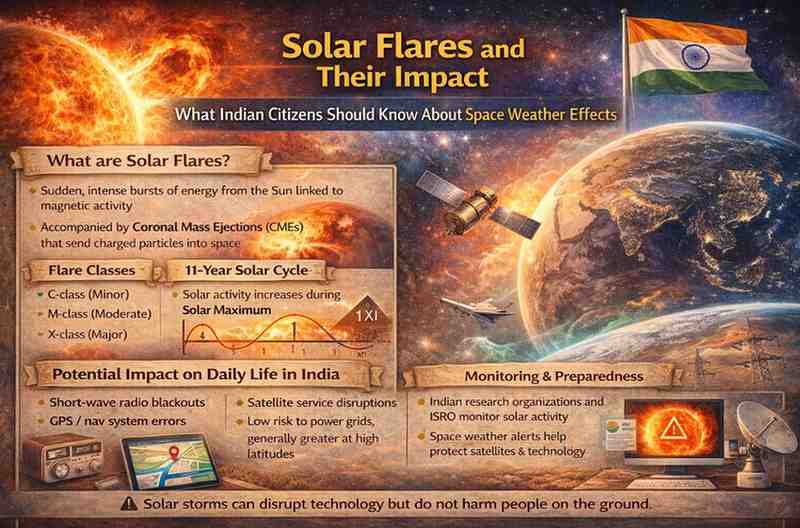
The Sun follows an approximately 11-year solar cycle, during which activity rises and falls. Periods of higher activity, known as solar maximum, see more frequent sunspots, flares and related phenomena. Periods of lower activity, or solar minimum, are comparatively quiet. This cycle is well documented through more than a century of systematic observation.
Solar flares are often discussed alongside coronal mass ejections, or CMEs. While flares are bursts of radiation that reach Earth at the speed of light, CMEs are clouds of charged particles that travel more slowly through space. Not all flares are associated with CMEs, but when both occur together and are directed toward Earth, the potential for technological impact increases.
How scientists classify solar flares
Solar flares are classified according to their peak X-ray intensity as measured by space-based instruments. The classification system uses letters — A, B, C, M and X — with each successive class representing a tenfold increase in energy output.
C-class flares are relatively common and generally have minimal effects on Earth. M-class flares are medium-strength events that can cause brief radio blackouts at high latitudes. X-class flares are the most intense and can trigger widespread radio disruptions and increase radiation exposure in near-Earth space.
These classifications are part of standard international space weather monitoring practice and are used by scientific agencies worldwide to assess potential impacts.
Space weather: from the Sun to Earth
The term “space weather” refers to the conditions in space influenced by the Sun and the solar wind — the continuous flow of charged particles from the Sun. When a strong solar flare occurs, high-energy radiation reaches Earth in about eight minutes, interacting first with the upper atmosphere.
This interaction can disturb the ionosphere, a layer of Earth’s atmosphere critical for long-distance radio communication. Changes in ionospheric density can affect high-frequency radio signals, which are still used in aviation, maritime operations and emergency communication systems.
If a flare is accompanied by a CME that strikes Earth’s magnetic field, it can cause geomagnetic storms. These storms induce electric currents in the magnetosphere and ionosphere, sometimes affecting ground-based technological systems.
India’s technological exposure to space weather
India is increasingly reliant on space-based infrastructure. Navigation systems, weather forecasting, telecommunications, television broadcasting, disaster management and financial networks all depend on satellites.
India operates its own navigation system, NavIC, and maintains a growing constellation of Earth-observation and communication satellites. These assets orbit in environments where radiation levels can rise during solar storms. Increased radiation can interfere with satellite electronics, degrade solar panels over time and, in severe cases, cause temporary malfunctions.
Ground-based systems can also be affected. Long transmission lines, such as those used in power grids, can experience geomagnetically induced currents during strong geomagnetic storms. While India’s geographic location closer to the equator generally reduces the severity of such effects compared with higher-latitude regions, it does not eliminate the risk entirely.
Observed effects of solar flares on Earth
Historically, the most immediate effects of solar flares have been disruptions to radio communication. Sudden ionospheric disturbances can lead to short-wave radio blackouts on the sunlit side of Earth, lasting from minutes to hours depending on flare intensity.
Satellite systems may experience signal degradation or increased error rates. Global Navigation Satellite System signals, including those used for aviation and shipping, pass through the ionosphere and can be affected by rapid changes in electron density.
Astronauts in low Earth orbit are more exposed to radiation during solar events, which is why space agencies track solar activity closely and adjust extravehicular activities accordingly.
It is important to note that solar flares do not pose a direct health risk to people on Earth’s surface. The planet’s atmosphere and magnetic field provide effective shielding against harmful solar radiation.
Developments in monitoring and forecasting solar activity
Solar activity is monitored continuously by a network of ground-based observatories and space-based instruments. International collaboration is central to this effort, with agencies sharing data to improve forecasting and risk assessment.
In India, solar and space weather research is conducted by multiple scientific institutions, including the Indian Space Research Organisation, which operates satellites and supports research into space environment effects on spacecraft.
India has also launched dedicated missions to study the Sun, contributing to global understanding of solar processes. Data from such missions help refine models of solar activity and improve prediction of flares and related phenomena.
Globally, agencies such as the National Oceanic and Atmospheric Administration maintain space weather prediction centres that issue alerts and advisories based on observed solar activity. These alerts are used by satellite operators, airlines and power utilities to take precautionary measures.
What happens during a major solar event?
During a significant solar flare or geomagnetic storm, multiple sectors may take coordinated action. Satellite operators may place spacecraft in safe modes, delaying non-essential operations to reduce the risk of damage. Airlines may reroute flights away from polar regions where communication disruptions are more likely. Power grid operators may adjust system configurations to reduce vulnerability to induced currents.
These measures are based on established protocols developed through decades of experience and international cooperation. They are designed to manage risk rather than respond to emergencies in real time.
Impact on everyday life in India
For most Indian citizens, the effects of solar flares are subtle or invisible. Occasional disruptions to radio communication, brief navigation inaccuracies or minor satellite service interruptions may occur, but widespread or prolonged outages are rare.
Mobile phone networks, internet services and television broadcasting rely on a mix of terrestrial and satellite infrastructure. This redundancy helps limit the impact of space weather events. When disruptions do occur, they are usually short-lived.
Aviation and maritime sectors, which rely on precise navigation and communication, are more directly affected by space weather. These sectors operate under strict safety regulations and receive space weather advisories as part of routine operations.
Power grids and geomagnetic risk
Much public attention on solar storms focuses on the risk to power grids. Large geomagnetic storms can induce currents in long transmission lines, potentially damaging transformers. Such events have been documented in high-latitude regions.
India’s lower geomagnetic latitude reduces the likelihood of severe grid impacts, but researchers note that vulnerability depends on grid design, grounding practices and regional geology. Indian power utilities work with scientific agencies to assess and mitigate these risks as part of broader grid resilience planning.
Scientific uncertainty and responsible communication
Solar activity is inherently complex, and while forecasting has improved significantly, precise prediction of flare timing and intensity remains challenging. Scientists can identify active regions on the Sun and estimate probabilities, but exact outcomes cannot be guaranteed.
This uncertainty underscores the importance of responsible communication. Exaggerated claims about catastrophic impacts can cause unnecessary alarm, while underplaying risks can lead to complacency. Scientific agencies and the media have a shared responsibility to present accurate, contextual information.
Public awareness and preparedness
For the general public, preparedness does not involve personal protective measures but awareness of how space weather fits into broader technological systems. Understanding that temporary disruptions can occur helps set realistic expectations.
Educational outreach by scientific institutions plays a key role in demystifying space weather. Schools, universities and public science programmes increasingly include space science topics, reflecting their growing relevance.
India’s role in global space weather research
India’s expanding space programme has positioned it as an active contributor to global solar and space weather research. Observational data, modelling efforts and international collaborations enhance collective understanding of solar-terrestrial interactions.
Participation in international data-sharing frameworks ensures that Indian scientists and operators benefit from global expertise, while Indian observations add to worldwide datasets used to improve forecasting.
Looking ahead: why solar flares will remain relevant
As society becomes more technologically interconnected, sensitivity to space weather will continue to increase. Satellite mega-constellations, autonomous navigation systems and expanding power networks all heighten the importance of understanding solar activity.
At the same time, improved design standards, better forecasting and operational experience reduce vulnerability. The challenge lies in balancing technological advancement with resilience planning.
Conclusion
Solar flares are a natural and well-studied aspect of the Sun’s behaviour. While they can affect modern technological systems, they do not pose a direct threat to human life on Earth. For India, the key issue is not fear but informed preparedness ensuring that satellites, communication networks and power infrastructure are designed and operated with space weather in mind.
Ongoing scientific research, international cooperation and transparent communication remain central to managing space weather risks. For Indian citizens, understanding the basics of solar flares and their effects helps place occasional disruptions in context and underscores the quiet but essential work of scientists monitoring our dynamic Sun.
About the Author