
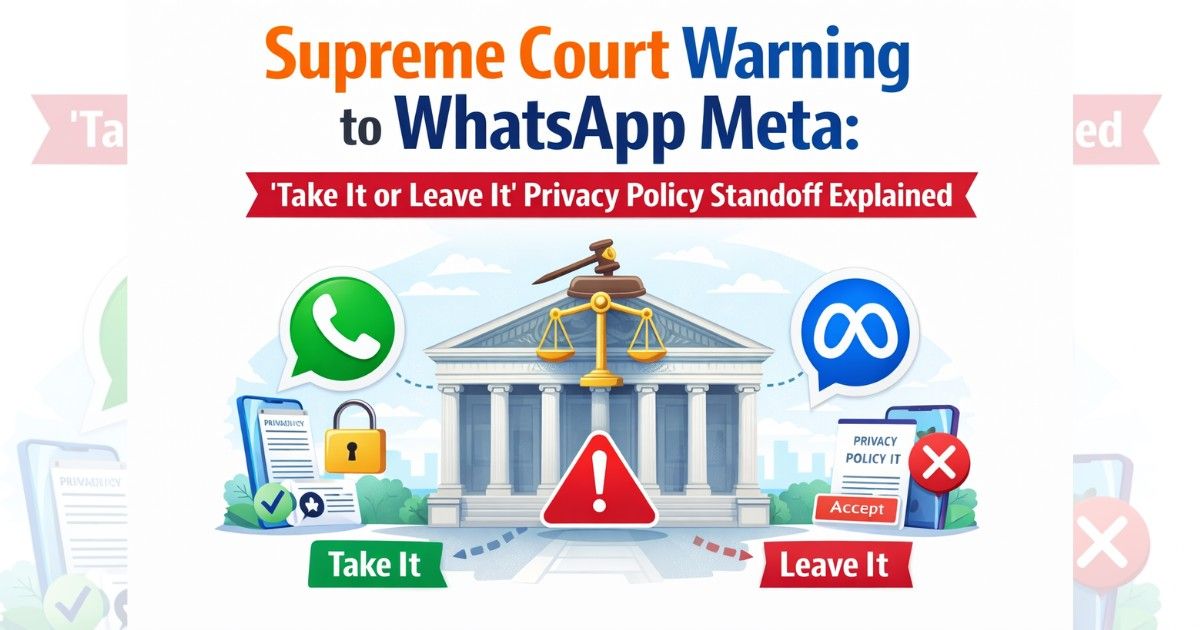
Supreme Court Warning to WhatsApp Meta has triggered a fresh debate around data privacy and user consent in India, following the court’s strong “take it or leave it” remark on Meta’s privacy policy. The observation has sent shockwaves across the tech ecosystem, pushing privacy concerns back into the national spotlight.
From a legal and consumer rights perspective, the Supreme Court Warning to WhatsApp Meta highlights growing discomfort over how digital platforms handle user data. As millions of Indians rely on WhatsApp for daily communication, the court’s stance has fueled widespread public interest, reflected in a sharp surge in privacy-related online searches.
What Triggered the Supreme Court Warning to WhatsApp Meta
The Supreme Court Warning to WhatsApp Meta stems from concerns over WhatsApp’s updated privacy policy, which critics argue leaves users with little real choice. The court questioned whether a “take it or leave it” approach respects user consent, especially when WhatsApp has become an essential communication tool.
Judges expressed concern that users are effectively forced to accept the policy or stop using the service altogether. This, the court noted, raises serious questions about fairness, consent, and the balance of power between tech companies and users.
The Supreme Court Warning to WhatsApp Meta was triggered by concerns over WhatsApp’s updated privacy policy, which many users argue leaves no real choice. During the hearing, the court questioned whether a “take it or leave it” approach can be considered valid consent, especially when WhatsApp has become essential for communication in India. Judges noted that users are effectively forced to accept the policy or stop using the platform, raising serious issues around fairness and data protection.
What “Take It or Leave It” Means in Legal Terms
From a legal standpoint, the Supreme Court Warning to WhatsApp Meta challenges the idea of forced consent. Indian law increasingly recognises that consent must be informed, voluntary, and meaningful not something imposed due to lack of alternatives.
The court’s remarks suggest that digital platforms cannot rely solely on user dependency to push policies without accountability. This could set an important precedent for how privacy agreements are interpreted in the future.
How WhatsApp’s Privacy Policy Affects Indian Users
For Indian users, the Supreme Court Warning to WhatsApp Meta brings attention to how personal data may be shared within the Meta ecosystem. Many users worry about transparency, data usage, and whether their information is adequately protected.
The issue resonates strongly in India, where WhatsApp is not just a messaging app but a critical tool for business, governance, and daily communication. Any policy that limits user choice naturally draws scrutiny.
What This Means for Digital Privacy and Big Tech in India
The Supreme Court Warning to WhatsApp Meta could mark a turning point in India’s approach to regulating global tech companies. It reinforces the idea that digital platforms must align with Indian legal standards, not just global policies.
In the long run, this warning may encourage stronger privacy safeguards, clearer consent mechanisms, and greater accountability for big tech firms operating in India.
The Supreme Court Warning to WhatsApp Meta is more than a legal observation—it reflects India’s growing push to protect digital privacy in an increasingly data-driven world. By questioning forced consent, the court has placed user rights at the center of the conversation.
As privacy concerns continue to rise, the Supreme Court Warning to WhatsApp Meta could shape how technology companies design policies, ensuring that convenience and innovation do not come at the cost of user choice and data protection.
Also read: What You Should Know About the 7 New High-Speed Rail Corridors Connecting Major Indian Metro Cities
Add India News Bulletin as a preferred source on Google – Click Here
About the Author