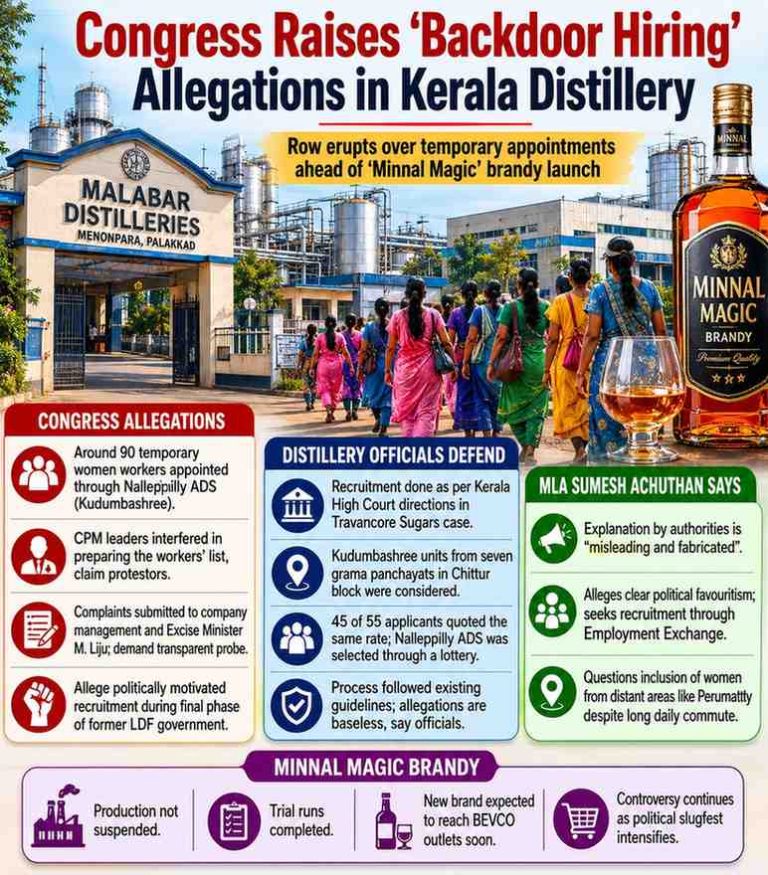
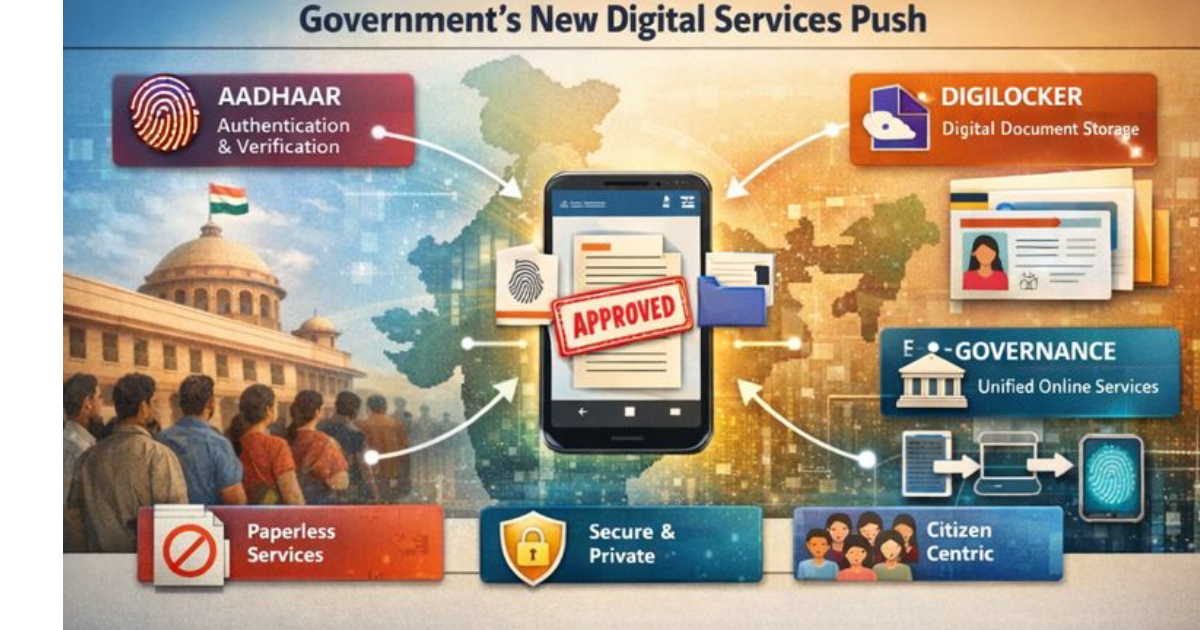
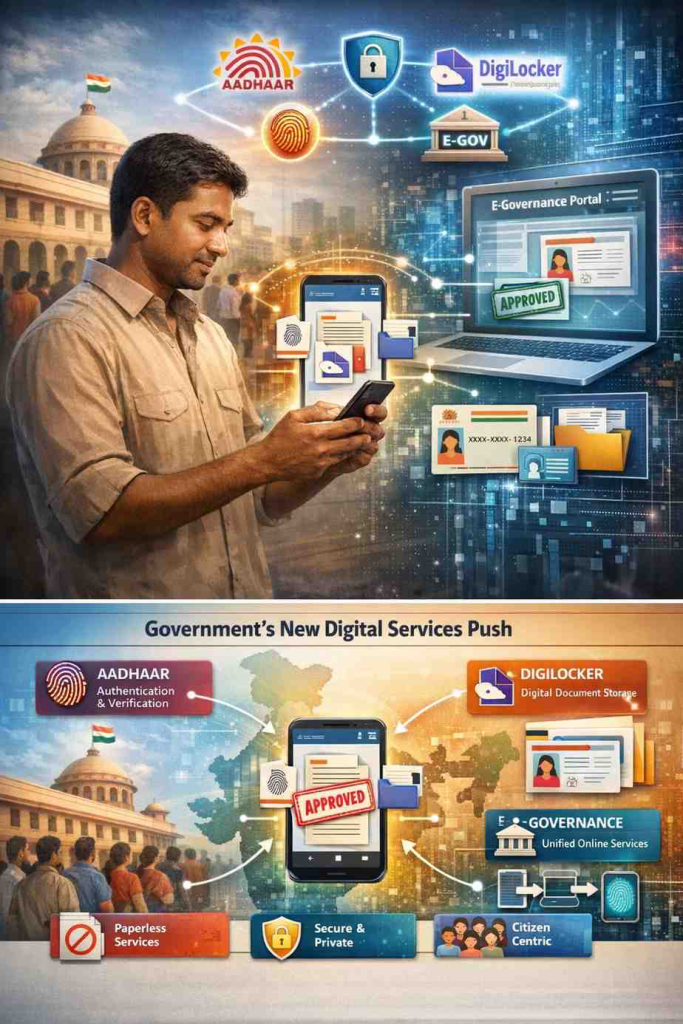
Government’s new digital services push aims to integrate Aadhaar, DigiLocker, and e-governance platforms to deliver faster, paperless, and citizen-centric public services.
The government’s latest digital services push signals a decisive shift from building digital platforms to deepening their everyday use across governance, welfare delivery, and citizen services. After a decade of rolling out Aadhaar, UPI, DigiLocker, and a range of e-governance portals, the focus is now on integration, ease of use, and trust. The aim is clear: make digital services invisible in daily life, where accessing a certificate, availing a subsidy, or verifying identity feels as routine as making a phone call.
This renewed push comes amid rising smartphone penetration, expanding broadband coverage, and increasing public comfort with digital transactions. For millions of citizens, especially first-time digital users in semi-urban and rural areas, the government wants services to work seamlessly across platforms without repeated paperwork or physical visits to offices.
Aadhaar’s Expanding Role Beyond Identity
Aadhaar is no longer positioned merely as a proof of identity. Under the new digital services strategy, it is increasingly being used as a consent-based authentication layer that enables faster service delivery while attempting to address long-standing privacy concerns.
The emphasis is on minimal data sharing. Instead of handing over photocopies of Aadhaar cards, users are being encouraged to rely on QR-based verification, masked Aadhaar, and offline Aadhaar features. These tools allow individuals to prove their identity without exposing their full Aadhaar number, reducing the risk of misuse.
At the same time, Aadhaar-linked authentication is being expanded for services such as pension disbursement, healthcare access, and education-related benefits. For citizens, this means fewer delays caused by duplicate records or manual verification. However, it also places greater responsibility on the system to ensure uptime, accuracy, and grievance redressal, especially for those who face biometric authentication failures.
DigiLocker Moves from Storage to Service Hub
DigiLocker is undergoing a quiet but significant transformation. Initially designed as a digital repository for documents, it is now being positioned as an active service hub within the e-governance ecosystem.
Under the new push, more government departments, universities, transport authorities, and financial institutions are being onboarded to issue documents directly into DigiLocker. Birth certificates, school marksheets, driving licences, insurance policies, and even land records are increasingly available in verified digital form.
For users, this reduces dependence on physical documents and eliminates the need for repeated verification. DigiLocker’s integration with Aadhaar and mobile-based authentication allows instant access while maintaining a record of when and where documents are shared. The government is also encouraging private entities, such as banks and employers, to accept DigiLocker documents as legally valid, further strengthening its role in daily transactions.
Interoperability at the Heart of e-Governance
One of the most important aspects of the government’s digital services push is interoperability. Rather than standalone portals for each department, the focus is on systems that talk to each other securely.
This means a citizen updating an address once can see the change reflected across multiple services, from ration cards to vehicle registration, without filing separate applications. Backend integration using APIs and common data standards is intended to reduce duplication, errors, and delays that have traditionally plagued public service delivery.
For users, the visible impact is simpler interfaces, fewer forms, and quicker approvals. For the administration, it promises better data-driven policymaking and more efficient monitoring of welfare schemes.
Citizen-Centric Design and Language Inclusion
Recognising that technology adoption depends heavily on usability, the new digital services approach places strong emphasis on citizen-centric design. Government apps and portals are being redesigned to work better on low-end smartphones, slower internet connections, and smaller screens.
Language inclusion is another key priority. More services are being made available in regional languages, with voice-based navigation and assisted modes for users who may not be comfortable with text-heavy interfaces. This is particularly significant for rural users and senior citizens, who often rely on local facilitation centres or family members to access digital services.
The goal is to reduce the digital divide not just through infrastructure, but through design choices that respect how people actually use technology.
Data Protection and Trust as Central Challenges
As digital services expand, concerns around data protection and privacy have moved to the centre of public discourse. The government’s digital push is closely linked with the evolving data protection framework, which aims to define how citizen data is collected, stored, and used.
For Aadhaar, DigiLocker, and other platforms, this means stricter access controls, clearer consent mechanisms, and greater accountability for data breaches. Users are being given more visibility into how their data is shared, along with options to revoke access where possible.
Trust will be critical. Any large-scale data leak or system failure could undermine confidence built over years. The success of the digital services push will depend not just on technology, but on transparent governance and responsive grievance redressal systems.
What This Means for Everyday Users
For the average citizen, the government’s new digital services push promises convenience, speed, and reduced paperwork. Tasks that once required multiple visits to offices, attested copies, and long waiting periods are increasingly being completed online or through assisted digital channels.
At the same time, users will need to be more aware of digital hygiene, from protecting OTPs to understanding consent prompts. As services become more interconnected, a single digital identity unlocks multiple benefits, but it also requires greater vigilance.
The Road Ahead for Digital Governance
The government’s digital services push marks a transition from digitisation to digital governance maturity. Aadhaar, DigiLocker, and integrated e-governance platforms are no longer experiments; they are foundational infrastructure shaping how citizens interact with the state.
If executed well, this phase can make governance more inclusive, transparent, and efficient. If missteps occur, particularly around privacy or accessibility, they could slow adoption and erode trust. For now, the direction is clear: digital is not just an option, but the default pathway for public services in the years ahead.
Add indianewsbulletin.in as a preferred source on google – click here
About the Author