Key Updates on Competitive Exams: Understanding Changes in Exam Patterns and Evaluation Methods for Students.
A Transformative Phase in Education and Assessment
In an era marked by rapid changes in pedagogy, technology and global competition, student assessments — from school board tests to high‑stakes national competitive exams — are undergoing sweeping reforms. The traditional exam formats that emphasized rote learning and one‑day performances are gradually giving way to more holistic, competency‑based models designed to evaluate deeper understanding, analytical ability and real‑world application. These changes are not merely cosmetic: they reflect a broader reimagining of what learning means in the 21st century and how students should be assessed to prepare them for evolving academic and career landscapes.
Dual Board Exams: Flexibility and Reduced Stress
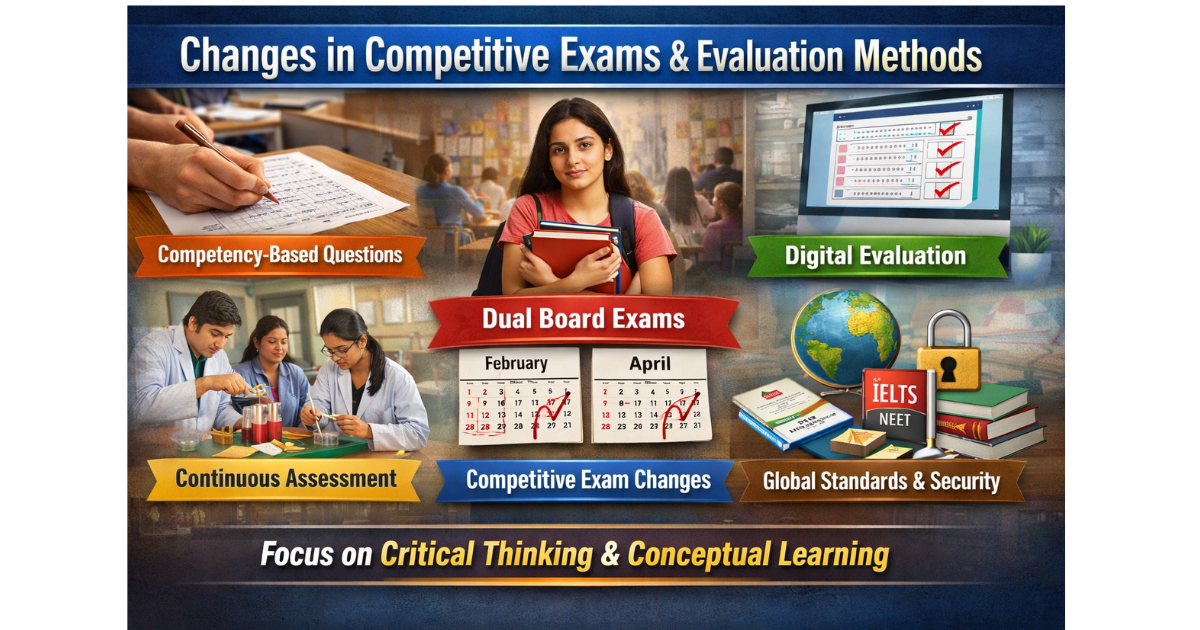
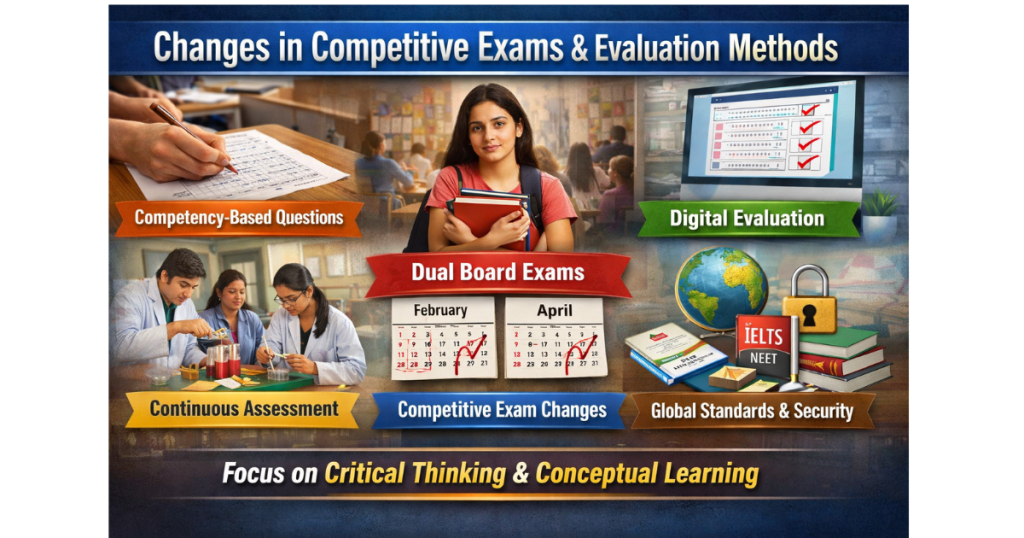
One of the most significant changes in the Indian school education system is the introduction of dual board exams for Class 10 students starting in 2026. Under the National Education Policy (NEP) 2020 reforms, students will have two opportunities annually — typically in February and April/May — to sit for their board examinations, with the best score being retained. This system is expected to ease the high stress traditionally associated with a single, high‑stakes exam. The reform also eliminates the need for supplementary exams by allowing students to improve their performance within the same academic year.
Shift to Competency‑Based Assessment
Across both secondary and higher secondary education, boards such as the Central Board of Secondary Education (CBSE) and the Council for the Indian School Certificate Examinations (CISCE) are dramatically altering question paper designs to emphasize competency, critical thinking and application of knowledge over memorization. More than 50% of question papers — including multiple‑choice questions, case studies, data interpretation and source‑based items — now focus on students’ ability to apply concepts to real‑life scenarios. This represents a major qualitative change from conventional recall‑oriented tests.
Greater Emphasis on Continuous Assessment
The evaluation system is also evolving. Schools and examination bodies are increasing the weight of internal assessments, practical exams, projects and periodic evaluations, with the aim of capturing a holistic picture of student capability over time rather than a snapshot on a single day. These changes encourage consistent effort and deeper learning rather than last‑minute preparation, aligning assessments with educational goals that prioritize skills and creativity.
Digital Evaluation and Transparency
To support these sweeping educational changes, digital evaluation methods are being introduced in board exams. This means answer sheets are scanned and assessed digitally, improving result turnaround times and reducing errors associated with manual checking. Reports suggest that digital evaluation systems will enhance transparency and consistency, as examiners input marks directly into secure digital platforms, allowing for more accurate and timely result declarations.
Competitive Exams Reinvented
Reforms are not limited to school board exams alone. National competitive examinations — from engineering and medical entrance tests to civil service selections — are also adapting to changing expectations.
For example, elite exams like the Union Public Service Commission’s Civil Services Examination (UPSC CSE)continue to refine their pattern and syllabus, maintaining rigorous stages such as Prelims, Mains and Interviews while also responding to broader trends in evaluation and candidate preparedness.
Other bodies such as the Staff Selection Commission (SSC) have introduced equi‑percentile normalisation methods in large‑scale exams to ensure fairness across different shifts, adjusting scores statistically to account for variations in paper difficulty. Additionally, measures like Aadhaar‑based candidate verification and secure digital distribution of question papers are part of efforts to strengthen examination integrity.
Alignment with Global Standards
These sweeping changes are also part of a broader alignment with global educational standards. Increasingly, assessment frameworks worldwide are shifting toward evaluating competencies, adaptability, digital literacy, and problem‑solving skills. Exams such as IELTS — widely used for international student admissions — are also being updated to reflect real‑world communication needs and digital test delivery trends.
Rationale Behind the Reforms
The underlying rationale for these reforms is clear: the world is moving away from industrial‑era education models rooted in memorization and uniform assessment toward systems that value analytical thinking, creativity, practical skills and lifelong learning. The National Education Policy (NEP) 2020, which guides many of India’s examination reforms, explicitly calls for a shift from rote learning to competency‑based education — an approach increasingly adopted by other leading educational systems globally.
Challenges and Opportunities
While these reforms promise positive outcomes, they also pose challenges. Transitioning teachers and students to new assessment paradigms requires extensive training and resources. Ensuring equitable access to quality preparation across socio‑economic backgrounds remains a priority. Moreover, some stakeholders express concerns about logistical complexities, especially in implementing dual exam systems or digital evaluations on a large scale.
However, proponents argue that the long‑term benefits of reducing exam stress, promoting deeper understanding, and preparing students for future challenges far outweigh the initial hurdles.
What Students Must Do Next
In light of these updates, students and parents must stay informed about the changing formats and evaluation methods. They are advised to focus on conceptual learning and critical thinking, incorporate regular practice of competency‑based questions, engage actively with internal assessments and take advantage of flexibility in board exam attempts. Adapting to digital tools, engaging with updated syllabi and leveraging mock tests aligned with new patterns can notably improve readiness for both school and competitive exams.
Add indianewsbulletin.in as a preferred source on google –click here
About the Author