India’s railway network entered a new phase of long-distance passenger travel in January 2026 with the operational launch of the first Vande Bharat Sleeper train. Designed to offer overnight semi-high-speed connectivity with modern onboard facilities, the sleeper variant marks a significant expansion of the Vande Bharat platform beyond short and medium-distance daytime routes. As Indian Railways prepares to scale up these services through 2026, questions around routes, ticket pricing, operational readiness and supporting infrastructure have come into sharper focus for passengers and policymakers alike.
Background: From daytime Vande Bharat to overnight sleeper services
The Vande Bharat programme represents one of the most visible modernisation efforts undertaken by Indian Railways in recent years. The first Vande Bharat Express services were introduced as fully air-conditioned, self-propelled trainsets aimed at reducing travel time between major city pairs during the day. These trains were positioned as faster, more efficient alternatives to conventional express services, with improved acceleration, modern interiors and enhanced passenger information systems.
However, the initial Vande Bharat trains were configured only with chair-car seating, limiting their suitability to journeys of a few hours. India’s vast geography and heavy reliance on overnight rail travel for distances exceeding 800 to 1,000 kilometres meant that a large segment of passengers continued to depend on traditional sleeper and air-conditioned overnight trains. Recognising this gap, Indian Railways began developing a sleeper-equipped Vande Bharat variant capable of handling long distances while maintaining higher average speeds.
The development of the Vande Bharat Sleeper train involved adapting the existing platform to accommodate berths, redesigned interiors, and overnight travel requirements without compromising on safety or performance. The project aligned with broader policy goals of improving passenger comfort, reducing journey times and strengthening inter-regional connectivity through modern rolling stock.
Policy context and institutional framework
Railway operations and passenger services in India fall under the purview of the Ministry of Railways, with Indian Railways acting as the implementing authority. Decisions regarding new train categories, fare structures, routes and deployment are taken within this institutional framework, guided by national transport priorities and operational feasibility.
The introduction of Vande Bharat Sleeper trains also fits into the government’s wider emphasis on infrastructure-led growth and public sector manufacturing. The trains are built domestically, involving public sector units and government-owned production facilities. This approach reflects a policy preference for indigenisation of rolling stock and associated components, while also ensuring long-term maintenance and scalability within the Indian railway ecosystem.
The first Vande Bharat Sleeper service: Route and configuration
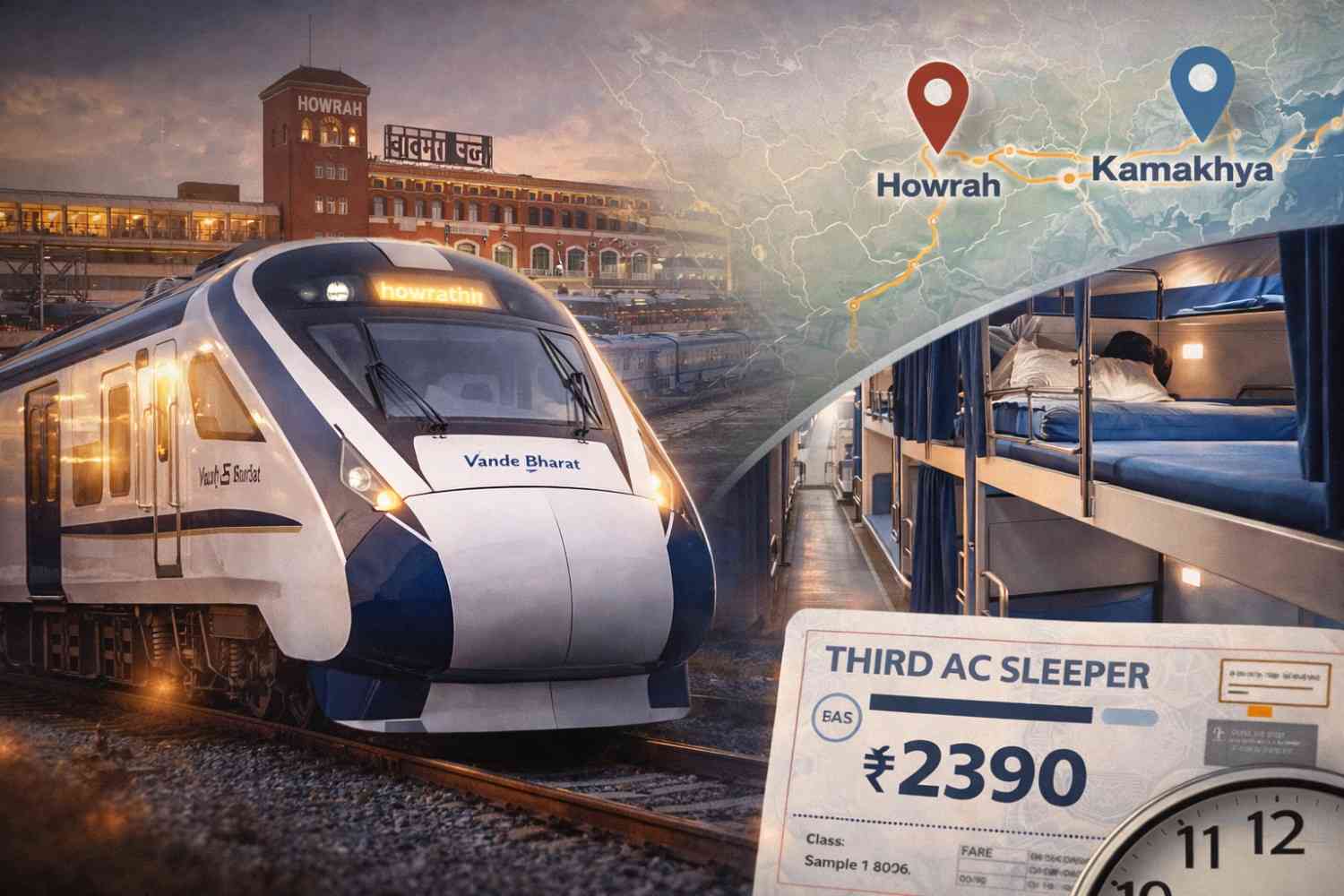
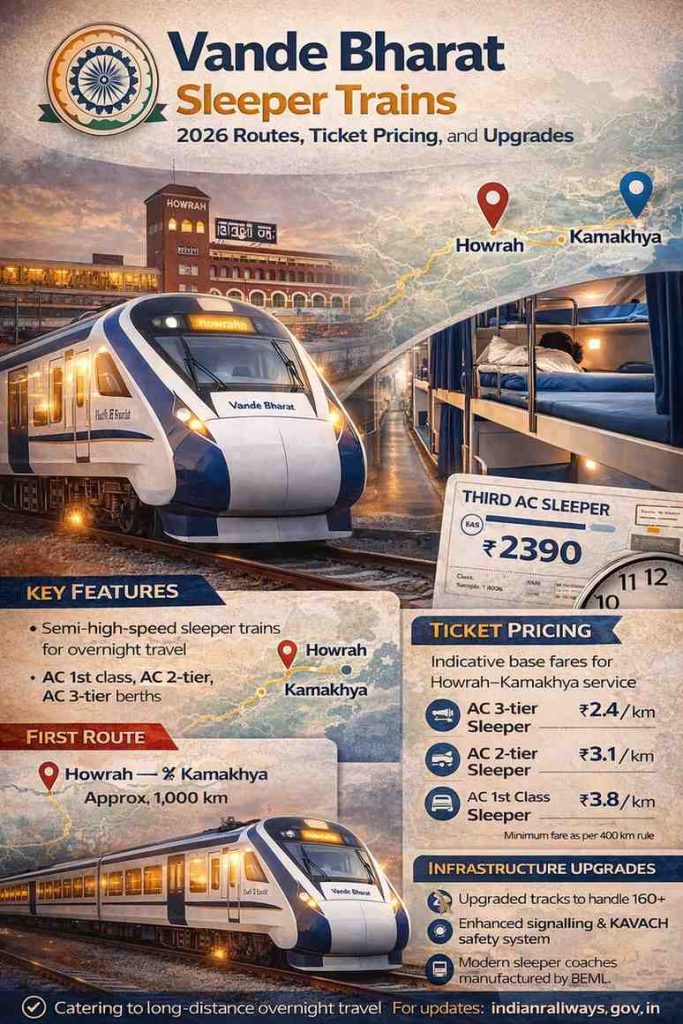
The inaugural Vande Bharat Sleeper service commenced operations on the Howrah–Kamakhya corridor, linking West Bengal with Assam and passing through multiple states in eastern and northeastern India. This route was chosen due to its strategic importance, high passenger demand and the need for improved overnight connectivity between the eastern heartland and the Northeast.
The service operates with a 16-coach configuration, entirely air-conditioned, and includes a mix of first-class AC, second-tier AC and third-tier AC sleeper accommodation. Unlike earlier Vande Bharat trains, which relied exclusively on seating, the sleeper variant provides full berths designed for overnight comfort.
The train is self-propelled, meaning it does not require a separate locomotive. This design allows for faster acceleration and deceleration, contributing to higher average speeds even when maximum speed limits vary across different track sections. Although the trainset is designed for high speeds, actual operating speeds are governed by track conditions, signalling systems and safety clearances on the route.
Journey time and operational performance
One of the key objectives of introducing sleeper-equipped Vande Bharat trains is to reduce overall journey time on long routes without sacrificing overnight convenience. On the Howrah–Kamakhya corridor, the Vande Bharat Sleeper offers a noticeably faster schedule compared to conventional overnight trains operating on the same alignment.
By combining improved acceleration with fewer technical halts and modern systems, the service achieves a higher average speed. For passengers, this translates into shorter overnight journeys and more predictable arrival times, an important consideration for business travellers, students and families.
Operational performance during the initial phase is being closely monitored by Indian Railways, as long-distance semi-high-speed services place additional demands on punctuality, maintenance and crew coordination.
Planned expansion of sleeper routes in 2026
The launch of the first Vande Bharat Sleeper train is not intended as a one-off initiative. Indian Railways has indicated plans to introduce multiple sleeper services across different regions during 2026. These planned routes are expected to cover distances generally ranging from 1,000 to 1,500 kilometres, targeting corridors where overnight demand is strong and where infrastructure is capable of supporting higher speeds.
While specific route announcements are made closer to operational readiness, the stated objective is to gradually build a network of Vande Bharat Sleeper services that complement both daytime Vande Bharat Express trains and traditional overnight services. This layered approach allows the railways to offer passengers a wider choice based on time, cost and comfort preferences.
Ticket pricing and fare principles
Ticket pricing for Vande Bharat Sleeper trains reflects their positioning as premium, modern services. The fare structure is distinct from that of conventional mail, express and even Rajdhani trains, taking into account factors such as higher speeds, improved onboard facilities and newer rolling stock.
One notable feature of the pricing policy is the application of a minimum distance fare. Under this rule, fares are calculated on the basis of a minimum journey distance even if the passenger travels a shorter segment. This approach standardises base pricing and aligns with the operational economics of running high-end long-distance services.
Fares are distance-based and vary by accommodation class. Third-tier AC sleeper is positioned as the most affordable option within the service, while first-class AC commands the highest fare due to lower berth density and additional privacy. Taxes and other statutory charges are applied as per existing railway fare rules.
Booking system and reservation rules
Vande Bharat Sleeper services follow a reservation system that differs in certain respects from traditional overnight trains. One significant change is the absence of reservation against cancellation and waiting lists. Passengers can book tickets only against confirmed berths available at the time of booking.
This system is intended to reduce uncertainty for passengers and improve clarity in ticketing. However, it also means that tickets can sell out quickly, particularly during peak travel periods, leaving limited options for late bookings. Early booking is therefore important for passengers planning to travel on these services.
Tickets are booked through the standard railway reservation system, with class-wise availability displayed in real time. Pricing is dynamic only in the sense of distance and class; it does not involve airline-style variable pricing.
Onboard facilities and passenger comfort
Passenger comfort is a central feature of the Vande Bharat Sleeper design. Coaches are equipped with modern air-conditioning systems, improved insulation for noise and vibration, and contemporary interiors. Each berth has individual reading lights and charging points, and common areas are designed to maximise usable space.
The trains are fitted with bio-vacuum toilets, which are more hygienic and environmentally friendly than older systems. Passenger information displays provide real-time updates on journey progress, and onboard CCTV enhances security. Fire detection and suppression systems are integrated into the coach design, reflecting updated safety standards.
The overall emphasis is on providing a consistent and predictable travel experience that aligns with expectations from modern long-distance transport.
Safety systems and technology integration
Safety remains a critical consideration for semi-high-speed operations, particularly over long distances and during overnight hours. Vande Bharat Sleeper trains are equipped with advanced safety technologies, including automatic train protection systems designed to reduce the risk of collisions and overspeeding.
These systems work in conjunction with upgraded signalling infrastructure along key routes. Centralised monitoring and diagnostics enable railway authorities to track train performance and respond quickly to anomalies. The integration of technology is intended to enhance both passenger safety and operational reliability.
Infrastructure upgrades supporting sleeper operations
The deployment of Vande Bharat Sleeper trains is closely linked to ongoing infrastructure upgrades across the rail network. Track strengthening, improved ballast, welded rails and enhanced electrification are all essential for sustaining higher average speeds over long distances.
Signalling upgrades, including the adoption of modern interlocking and train control systems, play a crucial role in enabling smoother operations. While not all routes are yet capable of supporting maximum design speeds, incremental improvements allow semi-high-speed services to operate more efficiently than conventional trains.
Maintenance facilities have also been upgraded to handle the specific requirements of Vande Bharat trainsets. Dedicated depots and trained personnel are essential to ensure reliability, particularly as the number of sleeper services increases.
Manufacturing and supply chain considerations
The production of Vande Bharat Sleeper trains relies on domestic manufacturing capabilities. Public sector units and railway production facilities are involved in building coach bodies, propulsion systems and control equipment. This approach supports the railways’ objective of reducing dependence on imports and building in-house expertise.
Component suppliers, including those providing traction equipment and electronic systems, play a key role in scaling up production. The ability to manufacture and maintain these trainsets domestically is seen as critical for long-term sustainability, especially as deployment expands across the network.
Impact on passengers and travel behaviour
For passengers, the introduction of sleeper-equipped Vande Bharat trains offers a new choice in long-distance travel. Faster overnight journeys allow travellers to make better use of their time, arriving earlier in the day and reducing fatigue associated with longer trips.
Business travellers, in particular, may benefit from improved reliability and reduced travel time, while families and leisure travellers gain access to a more comfortable overnight option. The availability of multiple accommodation classes ensures that the service caters to a range of income groups, although fares remain higher than those of some traditional trains.
Regional connectivity and economic implications
Enhanced overnight connectivity has broader economic implications, particularly for regions that are geographically distant from major metropolitan centres. The Howrah–Kamakhya route, for example, strengthens links between eastern India and the Northeast, facilitating movement of people for education, employment and tourism.
Improved rail connectivity can support regional development by making markets more accessible and encouraging investment. While rail services alone cannot drive economic growth, they form a critical part of the infrastructure needed to support broader development objectives.
Challenges and operational constraints
Despite their advantages, Vande Bharat Sleeper trains face certain challenges. Higher fares may limit accessibility for some passengers, particularly on routes where traditional overnight trains remain significantly cheaper. Managing demand and ensuring equitable access will require careful planning as more services are introduced.
Operationally, maintaining punctuality over long distances with mixed traffic remains a challenge. Freight trains, suburban services and other express trains share the same network, and balancing priorities requires sophisticated scheduling and coordination.
Future outlook for sleeper services
Looking ahead, Indian Railways is expected to continue expanding the Vande Bharat Sleeper fleet while refining operational practices based on early experience. Lessons learned from the initial services will inform decisions on route selection, scheduling and passenger amenities.
The long-term vision involves integrating sleeper and daytime Vande Bharat services into a cohesive network that offers modern travel options across different journey lengths. Continued investment in infrastructure and manufacturing capacity will be essential to realise this vision.
Conclusion
The introduction of Vande Bharat Sleeper trains marks a significant evolution in India’s long-distance passenger rail services. By combining overnight accommodation with semi-high-speed performance and modern amenities, these trains address a longstanding gap between daytime premium services and conventional overnight trains.
As routes expand, fare structures stabilise and infrastructure upgrades continue through 2026, the sleeper variant of the Vande Bharat platform is set to play an increasingly prominent role in shaping travel patterns across the country. For passengers, policymakers and railway planners alike, its performance over the coming year will be closely watched as an indicator of the future direction of Indian rail travel.
Add indianewsbulletin.in as preferred source on google – click here
About the Author