

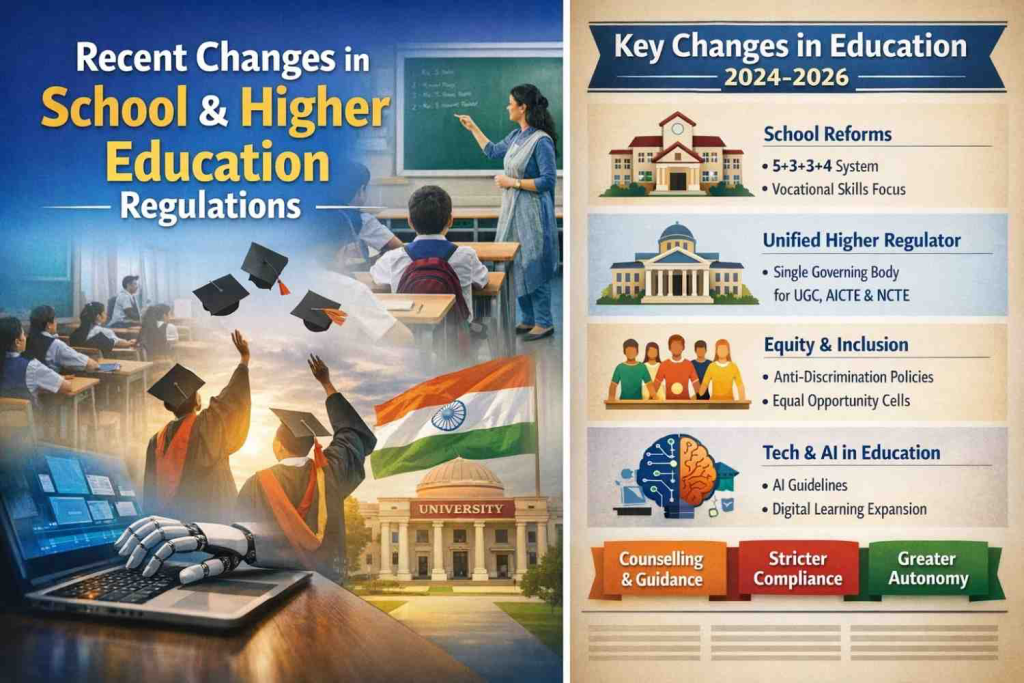
An infographic explaining key regulatory changes in school and higher education, including curriculum restructuring, unified governance, and increased focus on equity and digital learning.
Education systems across India are undergoing one of their most significant regulatory transitions in decades. From reforms in school affiliation norms to sweeping changes in higher education governance, recent regulatory updates aim to modernise learning, improve institutional accountability, and align education with evolving economic and social realities. These changes, driven largely by the long-term vision of the National Education Policy (NEP) 2020, are beginning to reshape how schools and universities operate, teach, and support students.
A New Direction for School Education
School education reforms over the past year reflect a clear move away from rigid, infrastructure-heavy regulations toward more flexible and student-centric norms. Education boards and state authorities have increasingly focused on learning outcomes, student wellbeing, and access rather than only physical compliance.
One of the most visible shifts has been the continued implementation of the 5+3+3+4 academic structure, which integrates early childhood education into the formal schooling system. This structural change aims to strengthen foundational learning and reduce learning gaps that emerge at later stages. Curriculum revisions aligned with this structure are placing greater emphasis on conceptual understanding, experiential learning, and interdisciplinary approaches.
Changes in School Affiliation and Infrastructure Norms
Recent updates to school affiliation rules, particularly by national boards, have introduced greater flexibility in land and infrastructure requirements. These relaxations are intended to address long-standing challenges faced by schools in densely populated urban areas and geographically constrained regions. By easing land norms while maintaining safety and academic standards, regulators hope to encourage the establishment of quality schools in underserved locations.
At the same time, regulatory focus has expanded beyond buildings and classrooms to include student support systems. Schools are now being required to strengthen counselling and career guidance services, recognising the growing mental health pressures on students and the increasing complexity of academic and career choices. This marks a shift in regulation from purely administrative oversight to holistic student development.
Teacher Standards and Professional Accountability
Another important area of reform concerns teacher qualifications and professional development. Several states and boards are reviewing eligibility norms, training requirements, and evaluation mechanisms for teachers. The objective is to ensure that educators are better equipped to deliver competency-based curricula and adapt to new pedagogical methods, including digital and blended learning models.
While implementation varies across regions, the broader regulatory direction signals higher expectations from teachers, along with increased emphasis on continuous professional learning rather than one-time certification.
Unified Regulation in Higher Education
Perhaps the most consequential regulatory change is unfolding in higher education. The government’s move toward establishing a unified higher education regulator represents a fundamental restructuring of oversight mechanisms. This proposed system seeks to replace multiple regulatory bodies with a single authority responsible for standards, accreditation, and institutional governance, excluding professional fields such as medicine and law.
The rationale behind this reform is to reduce regulatory overlap, improve transparency, and grant greater academic autonomy to institutions that demonstrate quality and compliance. If fully implemented, the new framework could significantly alter how universities are approved, monitored, and evaluated, shifting the emphasis from procedural control to outcome-based regulation.
Stronger Focus on Equity and Student Protection
In parallel with governance reforms, higher education regulations are placing renewed emphasis on equity, inclusion, and student rights. Universities are now expected to implement stronger mechanisms to prevent discrimination and ensure fair treatment of students from diverse social and economic backgrounds.
Mandatory grievance redressal systems, equal opportunity cells, and clearer disclosure requirements are being introduced to make institutions more accountable. Regulators have also indicated that non-compliance in these areas could have serious consequences, including penalties and loss of recognition, signalling a stricter enforcement environment.
Technology, AI, and Digital Governance in Education
Technology has emerged as a central consideration in recent regulatory thinking. From digital classrooms in schools to artificial intelligence tools in universities, regulators are increasingly concerned with ethical use, data privacy, and academic integrity.
Globally and within India, educational authorities are encouraging institutions to develop formal guidelines for the responsible use of AI in teaching, assessment, and research. These measures aim to balance innovation with safeguards against misuse, plagiarism, and unequal access to digital resources.
What These Changes Mean for Students and Institutions
For students, the regulatory changes promise greater flexibility in learning pathways, stronger support systems, and improved safeguards against unfair practices. Parents may benefit from clearer quality benchmarks and increased transparency in how institutions are run.
For schools and universities, however, the transition brings both opportunity and pressure. While streamlined regulations and greater autonomy could foster innovation, institutions must also invest in compliance, faculty development, and student services to meet rising regulatory expectations.
Looking Ahead
The recent changes in school and higher education regulations signal a decisive shift in how education is governed in India. The focus is moving steadily from control to quality, from uniformity to flexibility, and from infrastructure-driven rules to learner-centric frameworks. While challenges in implementation remain, particularly across diverse regions and institutions, the regulatory direction is clear.
As these reforms take deeper root, their success will ultimately depend on effective execution, institutional readiness, and continuous dialogue between policymakers, educators, and learners. What is certain is that India’s education landscape is entering a phase of transformation that will shape classrooms and campuses for years to come.
Also read : https://newsestate.in/how-recent-policy-decisions-could-influence-indias-economic-growth-outlook/
Add indianewsbulletin.in as a preferred source on google – click here
About the Author